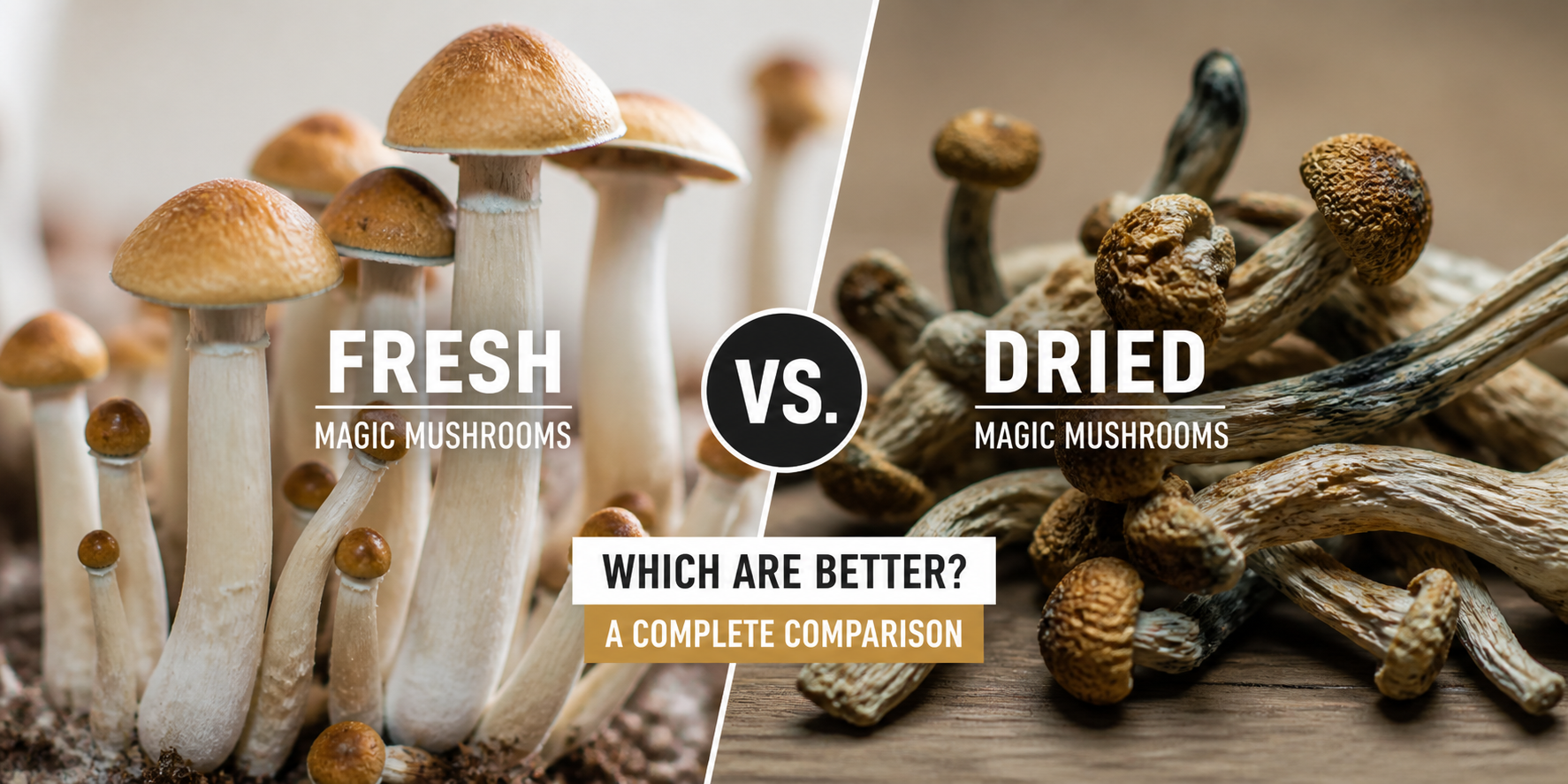
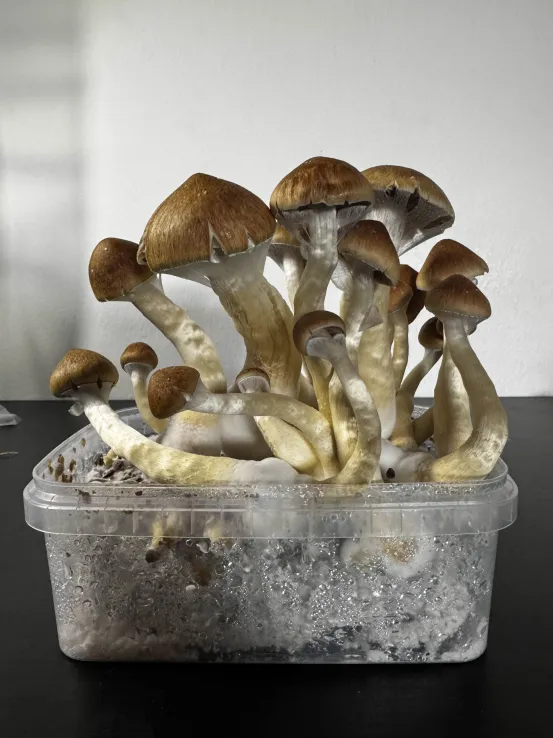
If you’ve ever stood in front of a shelf of psilocybin products and wondered whether to reach for the fresh tray or the dried jar, you’re not alone. The fresh-versus-dried question is one of the most common we hear from our customers – and it goes deeper than most people realize.
The short answer: dried mushrooms are stronger by weight, but fresh mushrooms can hit faster and feel different. Neither is universally “better.” The right choice depends on what you’re trying to do, how you plan to dose, and how long you need to store them.
Below, we break down the chemistry, the dosing math, the effects, and the practical trade-offs so you can choose with confidence.
The chemistry: psilocybin vs. psilocin
Magic mushrooms produce two related psychoactive compounds: psilocybin and psilocin. Psilocybin is a prodrug – your body converts it to psilocin, which is the molecule that actually crosses the blood-brain barrier and produces the effects.
Fresh mushrooms contain a higher proportion of psilocin. Drying – especially under heat – degrades some of that psilocin, but it also stabilizes the remaining psilocybin, which is far more shelf-stable. The result is two products with similar end effects but different chemical fingerprints.
This is the single most important fact for understanding the rest of the comparison: when you eat dried mushrooms, your body has to do an extra step (psilocybin to psilocin) before you feel anything. With fresh, more of the active compound is already present and bioavailable.
Potency: by weight vs. by piece
Here’s where most beginners get tripped up.
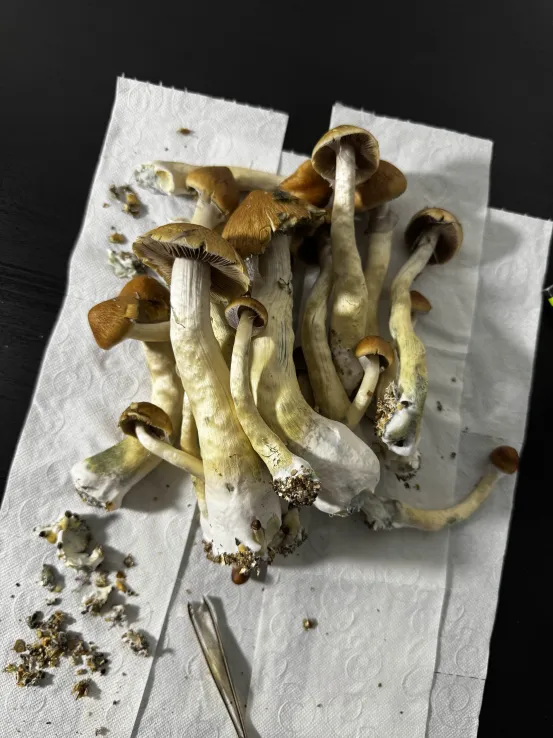
By fresh weight, magic mushrooms appear weaker. A fresh mushroom is roughly 90% water – the active compounds make up only a small fraction of what you’re holding. By dry weight, they are dramatically more concentrated, because all that water is gone.
The general rule of thumb most shops, harm-reduction sites, and clinical researchers use:
10 grams fresh = 1 gram dried (approx.)
So if a guide calls for “1 gram dried,” that’s roughly equivalent to 10 grams fresh. The 10:1 ratio is approximate – moisture content varies – but it’s the working number used in practice.
For magic truffles, the ratio is different. Truffles contain less water than fresh mushrooms (around 70%), so the conversion is closer to 3:1. Mixing up the ratios is one of the most common dosing mistakes we see, so it’s worth flagging clearly: never assume the mushroom rule applies to truffles.
Dosing: which is easier to get right?
Dosing accuracy is where dried mushrooms have a clear edge.
Because moisture content is stable in dried product, a kitchen scale gives you a reliable read. One gram dried is one gram dried, today and tomorrow. With fresh mushrooms, the same physical specimen can lose or gain water depending on storage conditions, temperature, and time on the shelf – so the same “10 grams” can mean meaningfully different doses across two sessions.
For microdosing, this difference matters even more. Microdosers work with tiny amounts (often 0.1-0.3 g dried), and the variability of fresh product can push you above or below your target threshold without you noticing. Most experienced microdosers prefer dried truffles or capsules for exactly this reason.
For full macrodoses in a structured setting, both forms are workable – but dried still tends to win on session-to-session consistency, which matters when you’re trying to repeat or refine an experience.
Effects: onset, intensity, and feel
Anecdotally, many users report that fresh mushrooms produce a faster, more vivid come-up. The likely explanation is the higher proportion of pre-formed psilocin, which doesn’t require enzymatic conversion before reaching the brain.
Dried mushrooms are typically reported as having a slightly slower onset (30-60 minutes vs. 20-40 for fresh), with a comparable peak intensity if dosed correctly. Some users describe dried trips as “smoother” or “more cerebral,” though these descriptions are subjective and influenced strongly by set, setting, and dose.
Duration is broadly similar – 4 to 6 hours of peak experience, with a longer afterglow tail.
Taste is a real factor too. Fresh mushrooms are earthier and milder; drying concentrates the bitter notes and produces a tougher chew. If gag reflex or stomach sensitivity is a problem for you, fresh tends to be gentler going down.
Storage and shelf life
This is where dried mushrooms shine.
Fresh mushrooms keep for about 7 to 14 days in the fridge. They can be frozen for up to 6 months, but expect some quality loss. Long-term storage is not recommended — fresh psilocybin product is perishable and prone to mould.
Dried mushrooms, by contrast, last for months at room temperature in an airtight container. Frozen, they hold their potency for a year or more. Vacuum-sealed and stored somewhere cool and dark, you can comfortably keep them for over a year with minimal degradation.
In short: if you plan to use within a couple of weeks, fresh is fine. If you want anything longer than that, dried wins by a wide margin.
Pros and cons at a glance
Fresh magic mushrooms
-
More psilocin, faster onset, more vivid come-up
-
Milder taste, gentler on the stomach
-
Best within days of harvest
-
Harder to dose precisely due to variable moisture
-
Spoils quickly without refrigeration
Dried magic mushrooms
-
Higher concentration by weight; easier to dose accurately
-
Long shelf life with proper storage
-
More consistent batch-to-batch and session-to-session
-
Slightly slower onset and bitterer taste
-
Can be tougher on sensitive stomachs
Which should you choose?
Use this quick decision framework:
- Microdosing? Go dried (or capsules). Consistency matters most.
- Single ceremony or planned trip soon? Fresh, if available – the experience can feel more immediate.
- Stocking up or unsure when you’ll use them? Dried, every time.
- Sensitive stomach or first-timer? Fresh tends to be gentler going down.
- Travelling or transporting? Dried is far more practical.
In the EU specifically, fresh magic truffles are legal in the Netherlands and shipped widely under the principle of free movement of goods, while fresh mushrooms occupy a more restricted legal status. For most European customers, the practical question is fresh truffles vs. dried truffles – and the same logic above applies, with the truffle-specific 3:1 conversion rather than 10:1.
Final thoughts
There’s no objectively “better” form. Fresh and dried are two valid expressions of the same plant, with different strengths and use cases. Fresh feels more alive in the come-up; dried gives you control, shelf life, and dosing confidence.
If you’re new to psilocybin, we usually recommend starting with dried truffles in a measured microdose protocol. They give you the most predictable experience while you learn how your body responds. Once you know your baseline, experimenting with fresh can be a worthwhile next step.
Whatever you choose, remember the fundamentals: low and slow, set and setting, and never combine with alcohol or other psychoactive substances without doing your research first.
Fresh vs. Dried Magic Mushrooms – frequently asked questions
Are fresh or dried mushrooms stronger?
Per gram, dried are far stronger (roughly 10x). Per individual mushroom, the active dose is comparable – drying just removes water, not most of the compound.
Do dried mushrooms lose potency over time?
Yes, slowly. Properly stored, they retain most of their potency for a year or more. Heat, light, and humidity accelerate degradation, so airtight containers in a cool, dark place are ideal.
Can I dry fresh mushrooms at home?
Yes – air drying or using a food dehydrator at low temperatures (below 40C / 104F) preserves most of the psilocybin. Avoid high heat and ovens, which destroy potency. If you’re growing your own mushrooms with a grow kit, drying is the standard way to preserve your harvest for long-term use.
Why do truffles use a 3:1 ratio instead of 10:1?
Truffles have lower water content than fresh mushrooms (~70% vs. ~90%), so they lose less weight when dried. Always check whether a dosing guide is referring to mushrooms or truffles before measuring.
Is it safe to combine fresh and dried in the same dose?
Yes, as long as you account for both in your total. Convert each to its dried equivalent (10:1 for mushrooms, 3:1 for truffles) and add the figures. When in doubt, start lower than you think you need.