If you’ve ever picked a mushroom from the forest floor, lifted a fallen log to reveal a white, web-like substance underneath, or bought a grow kit and watched the cottony surface develop before the first pins appear, you’ve already met mycelium. What you saw was only a tiny fraction of the actual organism — and that’s the most important thing to understand about mycelium. The mushroom is not the fungus. The mushroom is what the fungus produces.
Mycelium is the real, living body of a fungus: a vast, branching network of microscopic threads that lives hidden inside soil, wood, dung, or substrate. It is older than land plants, more interconnected than the internet (literally — the analogy is borrowed from mycology), and is the engine that produces every mushroom you’ve ever seen. For anyone using a grow kit at home, understanding what mycelium is and how it behaves is the difference between a good harvest and a failed one.
This guide is the deep, practical explanation that most articles skip. We’ll cover what mycelium actually is at a cellular level, how it differs from a mushroom, the precise environmental conditions it needs to thrive, how it’s used inside modern grow kits, and how to recognise the difference between healthy mycelium and contamination. Toward the end, we’ll look at how Mindrush grow kits put all of this biology to work for home cultivators.
Table of Contents
1. What Is Mycelium? The Short Definition
2. Mycelium vs Mushroom: Why People Confuse Them
3. The Microscopic Anatomy: Hyphae, Cell Walls and Septa
4. The Life Cycle: From Spore to Network to Fruiting Body
5. How Mycelium Eats: The Most Efficient Decomposer on Earth
6. Optimal Growing Conditions for Mycelium
7. Mycelium Inside a Grow Kit: How It Actually Works
8. Healthy Mycelium vs Contamination: What to Look For
9. Why Grow Kits Are the Easiest Way to Work With Mycelium
1. What Is Mycelium? The Short Definition
Mycelium (plural: mycelia) is the vegetative body of a fungus, made up of a vast network of microscopic, branching, tubular filaments called hyphae. If you imagine an apple tree, the mycelium is the tree itself — roots, trunk, branches — and the mushroom is the apple. The mushroom is just the temporary reproductive structure the tree produces when conditions are right. The mycelium is the actual organism, alive year-round, doing the real work of feeding and surviving.
A single mycelial network can be microscopic, fitting comfortably inside a single grain of substrate, or it can be enormous. The largest known living organism on Earth is a mycelium of the honey fungus (Armillaria ostoyae) in Oregon’s Malheur National Forest, covering an estimated 9.6 square kilometres and weighing thousands of tonnes. It has been growing for an estimated 2,400 to 8,650 years.
The simplest way to think about it
Mycelium is the fungus. The mushroom is its fruit. Everything that makes a mushroom — its size, potency, colour, growing speed, and ability to produce more flushes — is determined by the health of the mycelial network underneath.
2. Mycelium vs Mushroom: Why People Confuse Them
In everyday language, “mushroom” usually refers to the whole fungus. In biology, this is wrong — but the confusion is understandable, because the mushroom is the only part of the fungus we typically see. Most fungi spend their entire lives as invisible mycelial networks, only producing mushrooms briefly when they reproduce.
Here is the biological reality, broken down:
The mycelium
- Role: The vegetative, feeding, growing body of the fungus. The actual organism.
- Lifespan: Long-lived. Years, decades, even millennia.
- Visibility: Usually hidden inside soil, wood, dung or substrate.
- What it does: Absorbs nutrients, breaks down organic matter, defends against competitors, communicates chemically with its environment.
The mushroom (fruiting body)
- Role: The reproductive structure. Equivalent to a plant’s flower or fruit.
- Lifespan: Short-lived. Days to a few weeks at most.
- Visibility: Visible above ground or substrate.
- What it does: Produces and disperses spores so the fungus can spread to new environments.
This distinction matters a lot for growers. When you receive a Mindrush grow kit, what you’re actually receiving is a container of substrate that has been fully colonised by living mycelium. The mushrooms haven’t appeared yet because conditions for fruiting haven’t been triggered. The hard scientific work — getting healthy mycelium to fully colonise a sterile substrate — has already been done in a professional lab. Your job is just to flip the switch from “vegetative growth” to “reproduce”.
3. The Microscopic Anatomy: Hyphae, Cell Walls and Septa
Zoom in on a piece of mycelium under a microscope and what you’ll see is not a single solid mass but countless individual filaments called hyphae (singular: hypha). Each hypha is a tube only a few micrometres in diameter, with a cell wall made of chitin — the same material found in insect exoskeletons. This is one of the key features that separates fungi from plants. Plant cell walls are made of cellulose; fungal cell walls are made of chitin, which is far stronger and more flexible.
Inside a hypha, the cytoplasm flows freely. Many fungi have internal cross-walls called septa that divide the hypha into compartments, but these septa contain pores large enough for cellular contents — including organelles and even nuclei — to flow between compartments. This means a single mycelial network functions as something between a colony and a single super-cell, with resources, signals, and even genetic material moving rapidly across long distances.
How mycelium grows: apical extension
Hyphae grow exclusively from their tips, in a process called apical extension. The tip cell pushes forward into the substrate, secreting digestive enzymes that break down the surrounding material into simpler molecules the fungus can absorb. Behind the tip, the cell wall hardens and the network becomes more permanent. Branches form behind the leading tips, creating the dense, fractal-like web we recognise as mycelium.
This growth pattern is incredibly efficient. A single hyphal tip can advance by a fraction of a millimetre per hour, but when you multiply this across the millions of tips in a mature mycelial network, the total daily expansion can cover surprising distances. In a healthy Psilocybe cubensis grow kit at optimal temperature, the visible mycelium can advance several centimetres per day.
Monokaryotic vs dikaryotic mycelium
Here’s where the biology gets genuinely interesting. When a single spore germinates, it produces what’s called monokaryotic mycelium — each cell contains a single nucleus. This mycelium can grow and absorb nutrients, but it cannot reproduce sexually or produce mushrooms.
To make mushrooms, two compatible monokaryotic mycelia must meet and fuse, in a process called hyphal anastomosis. The result is dikaryotic mycelium, where each cell contains two nuclei — one from each parent. This dikaryotic stage is what every mushroom-producing fungus actually exists as for most of its life. Only dikaryotic mycelium can be triggered to fruit and produce mushrooms when conditions are right.
This is why commercial grow kits use carefully selected, already-dikaryotic mycelium isolated from proven genetics. You skip months of waiting for compatible spores to find each other and fuse — the kit comes pre-loaded with mycelium that’s biologically ready to fruit the moment conditions are met.
4. The Life Cycle: From Spore to Network to Fruiting Body
To understand mycelium fully, it helps to walk through the complete fungal life cycle. Here’s how a mushroom-producing fungus typically lives:
Stage 1: Spore release
A mature mushroom releases millions to billions of microscopic spores from its gills (or pores, in some species). These spores are dispersed by wind, water, insects, or animals. A single Psilocybe cubensis cap can release roughly 1 to 2 billion spores during its few-day fruiting window.
Stage 2: Germination
If a spore lands somewhere with the right nutrients, moisture, and temperature, it germinates within 2 to 14 days. A thin hyphal thread emerges and begins to grow, feeding on whatever organic matter is around it. This is monokaryotic mycelium — alive but reproductively incomplete.
Stage 3: Mating and dikaryotic mycelium
As the monokaryotic mycelium expands, it eventually meets another compatible mycelium from a different parent spore. The two networks fuse, forming dikaryotic mycelium. From this point on, the fungus is biologically capable of producing mushrooms when conditions allow.
Stage 4: Vegetative colonisation
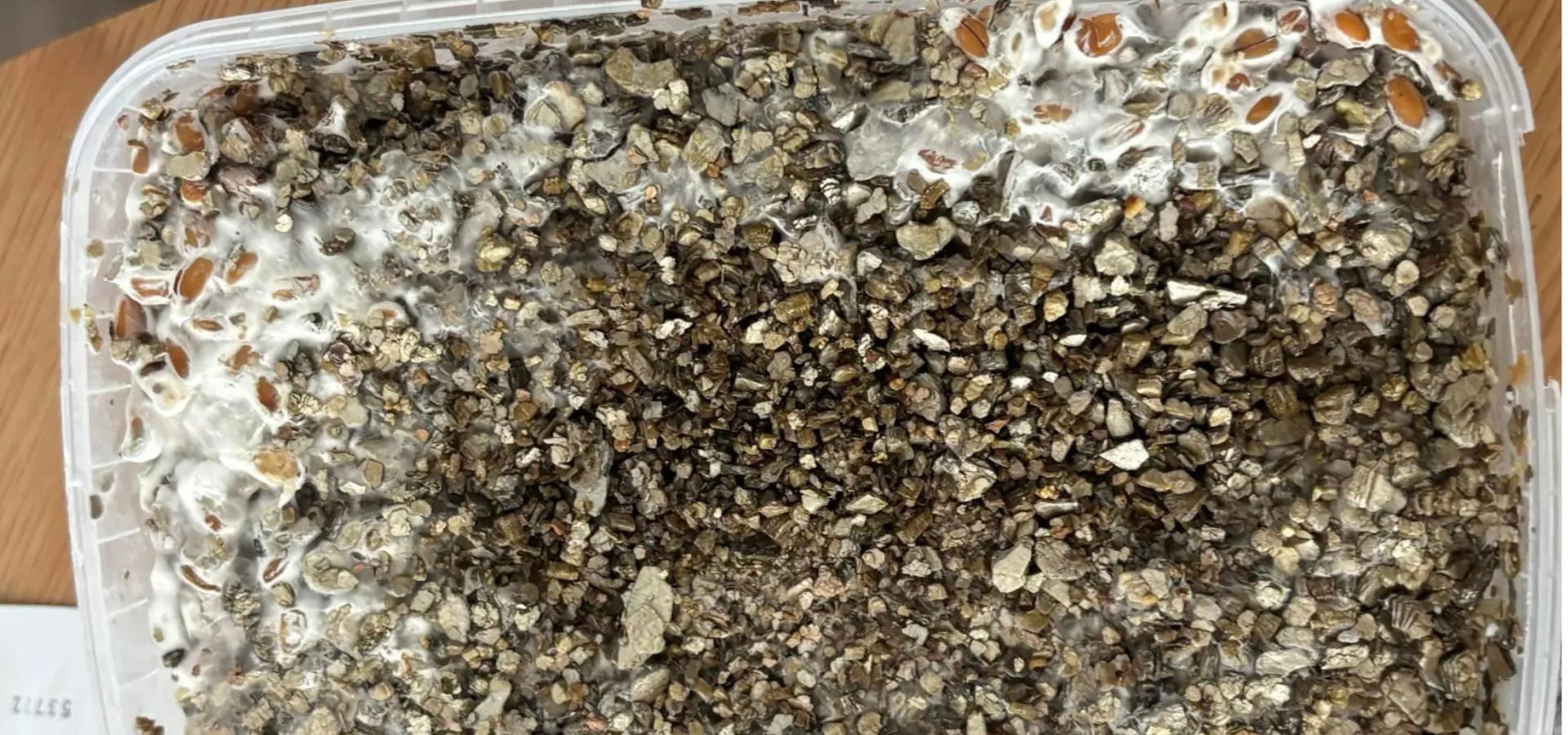
The dikaryotic mycelium continues to expand through its substrate, building up energy reserves and territory. This stage can last weeks, months, or years depending on the species, the substrate quality, and environmental conditions. In a grow kit, this is the stage you’d see if you opened it on arrival — a fully colonised block of white-and-cream mycelium ready to be triggered.
Stage 5: Fruiting trigger
When the mycelium senses certain environmental signals — typically a drop in temperature, increased fresh air, exposure to light, or local nutrient depletion — it begins a process called transcriptional reprogramming. Hyphal branching patterns change, and tightly interlaced hyphal knots form on the surface. These knots, called primordia or pins, are the earliest stage of mushroom development.
Stage 6: Mushroom development
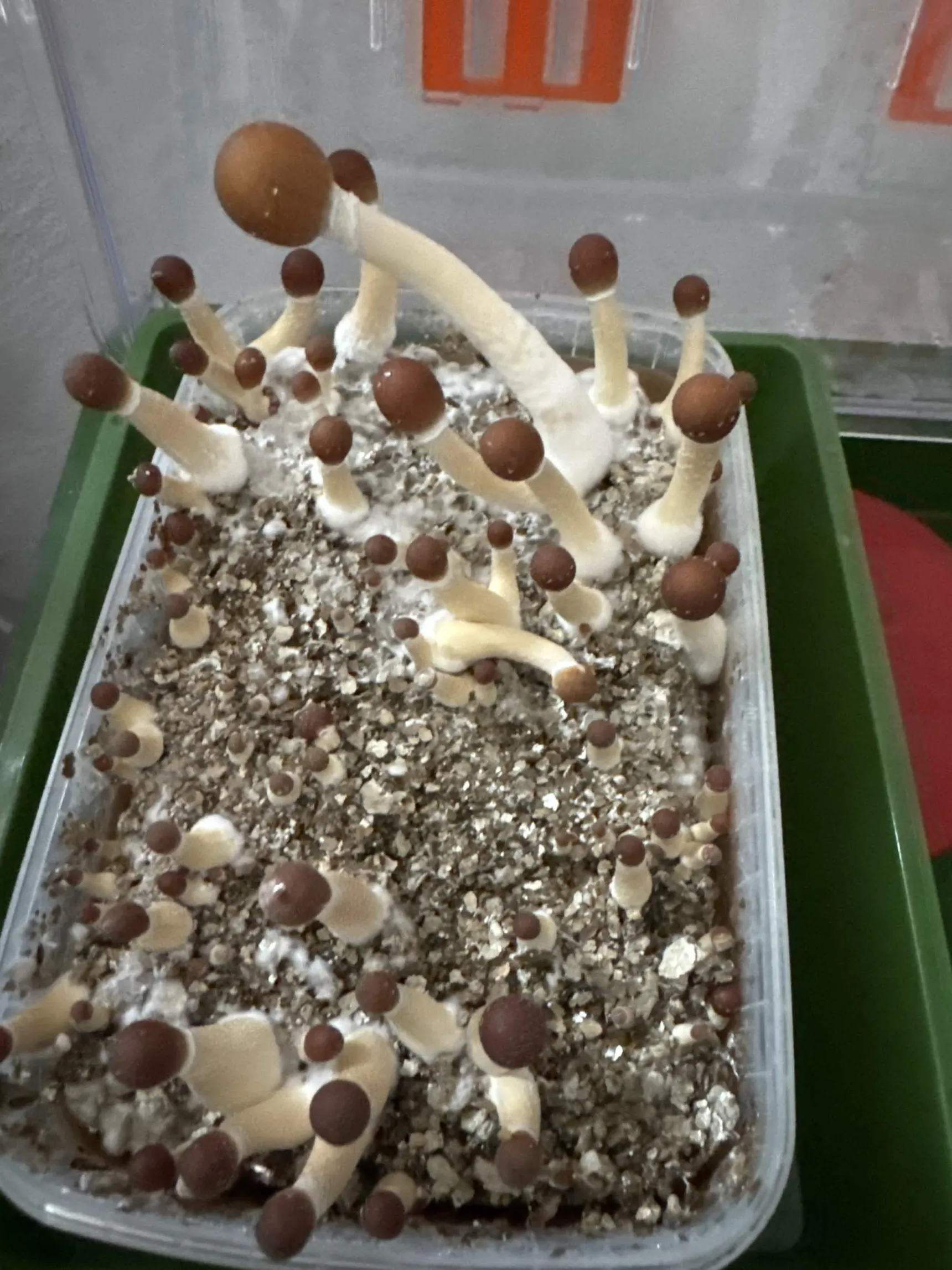
Pins develop into mature mushrooms over 5 to 14 days, depending on species. The mushroom is, structurally, just incredibly densely packed mycelium organised into a recognisable shape. Once the cap opens and the gills mature, the cycle restarts — billions of new spores are released, and the next generation begins.
The bit most people miss
When you grow mushrooms from a kit, you’re not really “growing mushrooms.” You’re providing the right environmental signals to trigger an already-mature mycelial network to switch from vegetative growth to reproduction. The mushroom is the result, not the goal — the mycelium does the actual living.
5. How Mycelium Eats: The Most Efficient Decomposer on Earth
Plants make their own food from sunlight via photosynthesis. Animals eat other organisms. Fungi do something completely different: they digest their food externally.
Mycelium grows directly into its food source — wood, leaf litter, dung, dead insects, even concrete in some species — and secretes powerful digestive enzymes through its hyphal walls. These enzymes break down the surrounding organic matter into simple molecules: sugars from cellulose, amino acids from proteins, lipids from fats. The mycelium then absorbs these molecules through its cell walls.
This external digestion is what makes fungi the planet’s most important decomposers. Without mycelium, dead trees would never rot, leaf litter would pile up indefinitely, and the carbon cycle would essentially stop. Mycelium is responsible for breaking down an estimated 85% of all dead plant material on Earth.
The substrate question
Different mycelia prefer different food sources. This is called substrate specificity, and it’s central to mushroom cultivation. Some examples:
- Psilocybe cubensis: Naturally grows on cattle and water buffalo dung in tropical grasslands. In cultivation, it thrives on grain (rye, wheat) and on coir/vermiculite substrates with added nutrients.
- Pleurotus ostreatus (oyster mushroom): A wood decomposer. Grows readily on straw, sawdust, coffee grounds, and even cardboard.
- Lentinula edodes (shiitake): Specialises in hardwood logs, particularly oak.
- Agaricus bisporus (button mushroom): Prefers composted manure, which is why commercial button mushroom farms smell the way they do.
Modern grow kits are optimised for the specific dietary preferences of the species inside them. A Psilocybe cubensis kit uses a substrate blend specifically designed for that fungus, which is why you can’t simply transplant the mycelium to a random soil and expect it to thrive.
6. Optimal Growing Conditions for Mycelium
Healthy mycelium needs four things: the right temperature, the right moisture level, the right gas balance, and the absence of competition. Get these right and the mycelium will thrive. Get them wrong and you’ll see slow growth, contamination, or both.
Temperature
This is the single most important variable. Mycelium is metabolically active and generates its own heat as it grows, but its enzymes only function properly within a narrow temperature window. For Psilocybe cubensis specifically:
- Below 20 °C (68 °F): Growth slows dramatically. Below 15 °C, it can stall completely.
- 20 – 24 °C (68 – 75 °F): Steady, healthy growth. Good for fruiting.
- 24 – 27 °C (75 – 81 °F): Peak colonisation speed. This is the sweet spot for the vegetative stage.
- Above 28 °C (82 °F): Growth slows again, and contaminant moulds and bacteria become more competitive. At 30 °C, mycelial growth is roughly two-thirds of what it is at the optimal 26 °C.
- Above 35 °C: The mycelium can be damaged or killed.
There’s an interesting historical note here. For decades, the mycology bible — Paul Stamets’ The Mushroom Cultivator — listed 86 °F (30 °C) as the optimal temperature for cubensis colonisation. Independent petri-dish testing by hobbyist mycologists in the 2000s showed this was actually too high; modern consensus places the true optimum at 75–81 °F (24–27 °C). It’s a small example of how cultivation knowledge keeps refining itself.
Moisture
Mycelium is roughly 90% water and cannot grow without sufficient moisture in its substrate. Too little water and the hyphae dehydrate and die back. Too much water and the substrate becomes waterlogged, oxygen levels drop, and bacteria take over. A well-prepared grow kit substrate has been calibrated to exactly the right moisture level — which is why Mindrush kits explicitly tell users not to add water before the first flush.
Gas exchange
Mycelium produces CO₂ as a byproduct of its metabolism, just like animals. During the vegetative colonisation stage, slightly elevated CO₂ levels (1,000 – 5,000 ppm) actually accelerate mycelial growth. But during fruiting, mushrooms need fresh air with normal CO₂ (400 – 1,000 ppm). Too much CO₂ during fruiting causes mushrooms to develop long, thin stems with tiny caps — a phenomenon called “stretching.”
This is why grow kits use a breathable filter bag during fruiting: it traps humidity but allows fresh air to slowly exchange, keeping CO₂ in the right zone.
Light
Mycelium doesn’t need light to grow — it’s not photosynthetic. But light is one of the key signals that triggers fruiting. Specifically, mycelium responds to blue and ultraviolet wavelengths. Indirect ambient daylight is enough; a desk lamp on a 12-on/12-off timer works equally well.
7. Mycelium Inside a Grow Kit: How It Actually Works
Now that you understand the biology, here’s what’s actually happening inside a Psilocybe cubensis grow kit, step by step.
Before the kit reaches you
In a sterile lab environment, technicians prepare a substrate blend (typically rye grain, vermiculite, gypsum, and other minerals) and pasteurise or sterilise it to kill all competing microorganisms. They then inoculate this substrate with carefully selected, already-dikaryotic Psilocybe cubensis mycelium from a proven genetic strain.
The inoculated substrate is incubated at the optimal 24–27 °C in a contamination-free environment for 2 to 4 weeks. During this time, the mycelium expands through the substrate, consuming nutrients and building up the energy reserves it will eventually use to produce mushrooms. By the time colonisation is complete, the substrate has visibly transformed: the original brown grain is now bound together by a dense white network of hyphae.
What you receive
Your kit arrives as a sealed container of fully colonised substrate. The mycelium is alive, healthy, and biologically ready to fruit — it’s just waiting for the right environmental signals. For more on what comes in the box and how to use it, our free mushroom growing guide walks through every step in detail.
Triggering the fruiting switch
When you set up your kit at home, you’re providing four specific environmental cues that tell the mycelium it’s time to reproduce:
- Slight temperature drop: From the lab’s 24–27 °C to your home’s 20–23 °C. This signals “the seasons are changing” in mycelial terms.
- Increased fresh air: The breathable bag allows CO₂ to escape and oxygen to enter, signalling that the substrate has been exposed to open environment.
- Exposure to light: Blue-spectrum daylight tells the mycelium that it’s at the surface, where spores can be effectively dispersed.
- Ambient humidity: High relative humidity inside the bag mimics the moist conditions in which wild Psilocybe cubensis naturally fruits.
These four signals together convince the mycelium that it’s time to produce mushrooms. Within 7 to 14 days, the first pins appear, and the cycle proceeds from there.
Why the first flush is the biggest
The first flush of mushrooms uses the mycelium’s accumulated energy reserves from the colonisation phase. Subsequent flushes have to be powered by additional nutrient extraction from what’s left of the substrate, which is why each flush is typically smaller than the last. The cold-shock between flushes (soaking the substrate in cold water for 12 hours) helps the mycelium rehydrate and access fresh nutrient pockets it hadn’t yet exploited.
8. Healthy Mycelium vs Contamination: What to Look For
One of the most useful skills any grower can develop is the ability to read what’s happening on the surface of their substrate. Here’s a quick visual guide.
✅ Signs of healthy mycelium
- White, cottony, or fluffy growth: Healthy mycelium. Often described as looking like white candyfloss or thick frost.
- Cream or pale yellow tinges: Normal as the mycelium ages. Not a problem.
- Small blue spots or patches: Bruising from handling or dryness. Caused by oxidation of psilocin compounds. Harmless and even a positive sign — it confirms you have an active psilocybin-producing strain.
- Small white or pinkish bumps after 1–2 weeks: These are pins — baby mushrooms. The kit is fruiting.
⚠️ Signs of contamination
- Bright green patches: Trichoderma mould — the most common grow kit killer. Powdery green patches that spread fast. Dispose of the kit.
- Grey or fluffy spreading growth: Cobweb mould. Spreads even faster than trichoderma. Dispose.
- Black or dark brown wet patches: Bacterial wet rot or heavy mould. Dispose and clean the area before starting another grow.
- Foul, sour, or rotting smell: Bacterial contamination. Healthy mycelium smells faintly earthy and pleasant. Anything foul means dispose.
For a deeper visual breakdown of every problem and its solution, see our dedicated article on common grow kit mistakes and how to avoid them.

9. Why Grow Kits Are the Easiest Way to Work With Mycelium
Working with mycelium from scratch is genuinely difficult. Sterile inoculation requires laminar flow hoods, pressure cookers, agar plates, and meticulous technique. A single airborne mould spore at the wrong moment can ruin weeks of work. This is why even experienced hobby growers often skip the spore-and-substrate stage entirely and start with a pre-colonised grow kit.
A grow kit removes the failure-prone steps and hands you the mycelium at exactly the moment it’s biologically ready to fruit. From your perspective, the work is small: hydrate it, cover it, give it stable conditions, and watch the mushrooms appear within 2 to 3 weeks.
At Mindrush.eu, we ship ready-to-grow mycelium grow kits produced in the Netherlands and shipped discreetly across most EU countries. Each kit contains a fully colonised substrate of healthy Golden Teacher mycelium (or other strains, depending on which kit you choose), produced under sterile lab conditions and ready to fruit straight out of the box.
From a single 1200 cc Mindrush kit, growers commonly harvest 350 to 500 grams of fresh mushrooms across three to four flushes. Smaller 250 cc kits are perfect for first-timers who want to learn the process before committing to larger harvests.
Two honest legal notes worth flagging: mycelium grow kits are legal under Dutch law because the kits contain only mycelium and substrate at the point of sale — no psilocybin, no mushrooms. Mindrush ships across the EU under Regulation 2019/515 on mutual recognition of goods, but the legal status of cultivating psilocybin mushrooms varies by country, and it’s the customer’s responsibility to verify the rules where they live before ordering.
10. Frequently Asked Questions
Is mycelium the same thing as a mushroom?
No. Mycelium is the actual living body of a fungus — a vast network of microscopic filaments. The mushroom is just the temporary reproductive structure that mycelium produces under the right conditions. Think of mycelium as the apple tree and the mushroom as the apple.
Does mycelium contain psilocybin?
Psilocybe cubensis mycelium does contain trace amounts of psilocybin and related compounds, but at much lower concentrations than the fruiting bodies (mushrooms). For practical purposes, the alkaloid content of a fully colonised but unfruited grow kit substrate is negligible — which is part of why grow kits are legally classified as containing no controlled substances at the point of sale.
How fast does mycelium grow?
Under optimal conditions (24–27 °C, healthy genetics, good substrate), Psilocybe cubensis mycelium can fully colonise a 1200 cc grow kit substrate in 10 to 21 days. Individual hyphal tips advance at a fraction of a millimetre per hour, but with millions of tips growing simultaneously, the visible expansion can be several centimetres per day.
Can I see mycelium with the naked eye?
Yes, when there’s enough of it. Individual hyphae are microscopic, but a dense network of them appears as the white, fuzzy or cottony growth you see in grow kits, on rotting logs, and underneath leaf litter on the forest floor. The largest mycelial network on Earth — a honey fungus in Oregon — covers over nine square kilometres.
What's the difference between mycelium and mould?
Both are types of fungi composed of hyphae, so technically all mould is mycelial. The distinction is colloquial: “mycelium” usually refers to the white, cottony growth of mushroom-producing fungi, while “mould” refers to faster-growing fungi (often green, black, or grey) that compete with mushroom mycelium for nutrients. In a grow kit, white = good; bright green, grey, or black = contamination.
Can mycelium communicate?
In a limited but genuine sense, yes. Mycelial networks transmit chemical and electrical signals between hyphae, and in forest ecosystems, mycorrhizal mycelial networks connect trees and allow them to share nutrients and warning signals. This research, popularised by Suzanne Simard and the term “wood wide web,” has fundamentally changed how scientists think about forest ecology.
How long does mycelium live?
It depends on the species and conditions. Inside a grow kit, the mycelium remains viable for several months in a cool, dark place before being activated. In nature, mycelial networks can live for centuries — the Oregon Armillaria network is estimated to be between 2,400 and 8,650 years old.
11. Final Thoughts
Mycelium is the part of the fungal kingdom that does the real work — feeding, growing, communicating, and shaping ecosystems. The mushroom is just the visible signature of all that hidden activity, the reproductive moment when the fungus briefly emerges into our world.
For home growers, understanding mycelium as the actual organism, and the mushroom as its temporary fruit, transforms how you approach a grow kit. You’re not really “growing mushrooms.” You’re providing the right environmental cues to a living network that already knows what to do. Get the temperature right, give it the airflow it needs, leave it alone when it asks to be left alone, and the mycelium does the rest.
If you’d like to put this knowledge into practice, Mindrush’s mycelium grow kits are produced in the Netherlands and shipped discreetly across the EU, with clear instructions and a free downloadable grow guide included. For new growers, the Golden Teacher strain is the most forgiving and beginner-friendly choice.
Whatever you choose to do with this knowledge — even if it’s just looking at a fallen log differently the next time you walk in the woods — mycelium is one of the most quietly extraordinary forms of life on this planet. Once you start seeing it, you start seeing it everywhere.
Disclaimer
This article is for informational and educational purposes only. Mindrush only sells products that are legal under Dutch law and intended for adult customers (18+). The legal status of cultivating psilocybin mushrooms varies by country; readers are responsible for verifying the laws that apply to them.