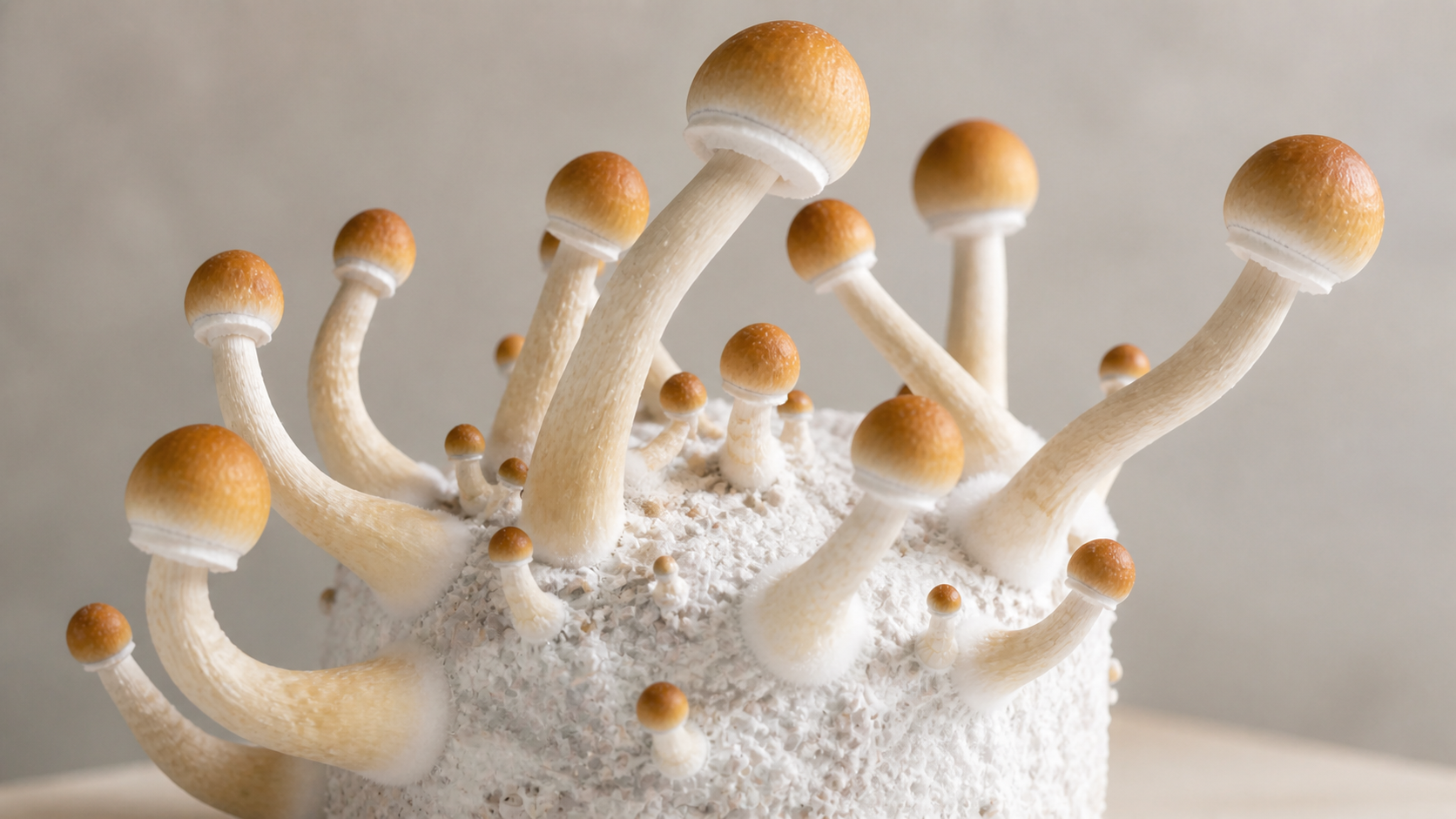
Out of the hundreds of known Psilocybe cubensis strains, none has earned a reputation quite like the Golden Teacher. Recognised by its honey-coloured caps, slim ringed stems, and the distinctly philosophical headspace it produces, this strain has shaped how an entire generation of mycologists, psychonauts, and researchers understand magic mushrooms.
It is, by a wide margin, the most cultivated cubensis variety on Earth. Its name shows up in everything from underground cultivation forums to clinical psilocybin research papers. And yet, despite this celebrity status, most articles about Golden Teachers stay disappointingly shallow — recycling the same five sentences about “gentle visuals” and “spiritual lessons” without explaining where the strain came from, what makes it biologically different from its cousins, or why it became the global benchmark in the first place.
This guide is the deep dive. We will cover the murky 1980s origin story, the actual chemistry behind the experience, dosage curves, comparisons with other famous strains (Penis Envy, B+, Mazatapec, Tidal Wave), step-by-step cultivation parameters, the legal landscape across Europe, and the renewed scientific interest in psilocybin therapy. Towards the end, we’ll also look at how a Golden Teacher grow kit works in practice — because if you’ve read this far, chances are you’re considering growing your own.
Table of Contents
1. What Is the Golden Teacher Mushroom?
2. The Mysterious Origin Story (1980s — Florida?)
3. Botanical Identification & Physical Characteristics
4. The Chemistry: Psilocybin, Psilocin & Tryptamine Cousins
5. Potency: How Strong Is Golden Teacher Really?
6. The Effects: Why It’s Called a “Teacher”
7. Dosage Guide (Microdose to Heroic)
8. Set, Setting & Harm Reduction
9. Golden Teacher vs. Other Famous Strains
10. How to Grow Golden Teacher Mushrooms at Home
11. Legal Status in the Netherlands and the EU
12. Modern Psilocybin Research & Clinical Trials
13. Why So Many People Start with a Grow Kit
1. What Is the Golden Teacher Mushroom?
Golden Teacher (sometimes labelled “GT” or, in older European catalogues, “Aurumescens”) is a cultivated strain — not a separate species — of Psilocybe cubensis. P. cubensis is itself a globally distributed dung-loving fungus naturally found in tropical and subtropical grasslands, growing on the manure of cattle and water buffalo across Central and South America, the southern United States, Southeast Asia, and northern Australia.
Within that one wild species, decades of selective isolation by amateur and professional growers have produced dozens of stable “strains”: Penis Envy, B+, Mazatapec, Cambodian, Tidal Wave, Ecuadorian, Albino A+, and many more. Strains differ in cap colour, growth speed, yield, contamination resistance, and — crucially — in tryptamine content.
Golden Teacher sits at the centre of this family. It is the reference point against which other cubensis strains are typically described. When a vendor says “slightly more potent than Golden Teacher” or “easier to grow than Golden Teacher”, they are using GT as the universal yardstick. That role didn’t come from marketing. It emerged organically because GT does three things very well at the same time: it produces large, photogenic mushrooms, it tolerates the imperfect environments of beginner growers, and it delivers a psychedelic experience that most people find emotionally manageable rather than overwhelming.
2. The Mysterious Origin Story (1980s — Florida?)
Unlike strains with clean pedigrees — Mazatapec was traced back to the Mazatec people of Oaxaca, Koh Samui to a specific Thai island — Golden Teacher has no documented birthplace. It simply appeared in cultivation circles during the late 1980s and spread like wildfire.
The most widely repeated theory is that the strain was isolated from a wild Psilocybe cubensis specimen found in the southeastern United States, most likely Florida. Florida’s humid climate, cattle ranches, and warm winters make it one of the few US states where P. cubensis grows truly wild and abundantly on cow patties. From an unknown grower’s collection in the late 80s, spore prints made their way through the early underground spore-trading network, and within a few years “Golden Teacher” had become a household name in mycology forums.
A competing hypothesis points to the Gulf Coast or even South America as the original wild source, with Florida simply being where it was first stabilised in cultivation. Honestly, no one knows for certain — and that uncertainty is part of the charm. The strain’s name is generally understood to come from two things: the rich golden-yellow cap colour, and its reputation for triggering insightful, almost “instructive” experiences.
What we can say with confidence is that by the early 1990s, Golden Teacher had displaced older strains like B+ and PF Classic as the default starter strain in the English-speaking cultivation community. By 2000, it had spread to European spore vendors and Dutch grow-kit producers, and it has held that dominant position ever since.
3. Botanical Identification & Physical Characteristics
Golden Teachers are among the larger, more elegant cubensis strains. Mature fruits typically display:
-
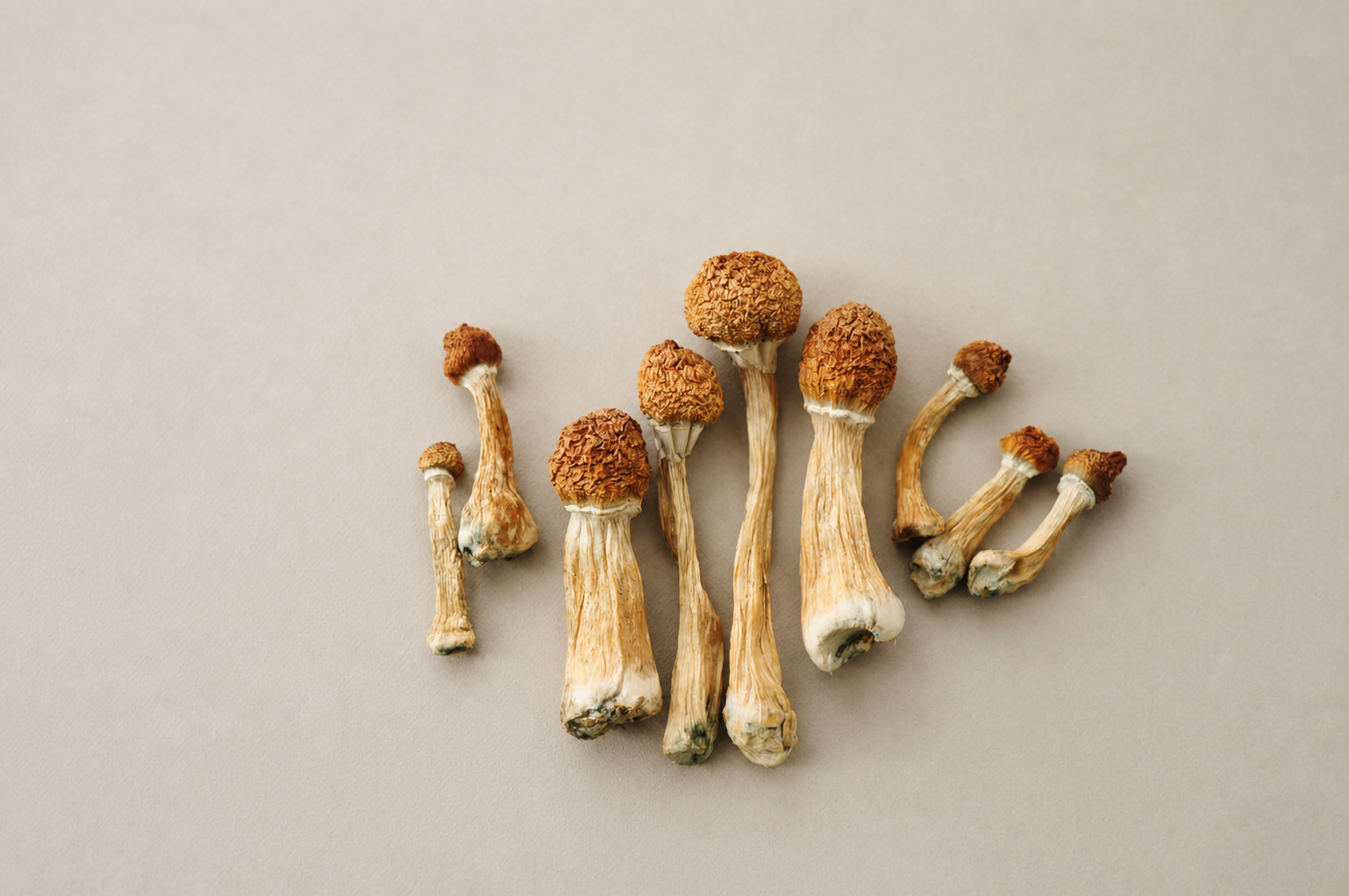
Cap: 3 to 6 cm in diameter, occasionally larger. Convex when young, flattening with age and often retaining a small central bump (umbo). The colour is the giveaway — a warm, caramel-to-honey gold, sometimes with paler yellow speckling.
-
Stem (stipe): Long, white to pale yellow, hollow inside, slightly thicker towards the base. A persistent partial veil leaves a distinct ring around the upper portion of the stem after the cap opens.
-
Gills: Start grey, darken to deep purple-black as spores mature. Spore prints are dark purple-brown.
-
Bruising: Like all psilocybin-containing mushrooms, GT bruises blue when handled or damaged. The bluing is caused by the oxidation of psilocin and is a useful (though imperfect) indicator of active alkaloid content.
-
Yield: Generous. Golden Teacher reliably produces multiple flushes from a single substrate, with each flush dropping somewhat in size.
One quirk that sets GT apart from many cubensis strains: its second flush is often comparable to — sometimes even larger than — the first. With most strains, flushes diminish steadily. With Golden Teacher, patience really does pay off.
4. The Chemistry: Psilocybin, Psilocin & Tryptamine Cousins
The active compounds in Golden Teacher are the same as in every other Psilocybe cubensis strain, just present in slightly different ratios.
Psilocybin (4-PO-HO-DMT)
This is the prodrug — the inactive precursor that you actually ingest. It’s chemically stable and water-soluble. After consumption, the body’s alkaline phosphatase enzymes strip a phosphate group from psilocybin, converting it into the active molecule, psilocin.
Psilocin (4-HO-DMT)
Psilocin is the molecule that crosses the blood-brain barrier and binds to serotonin receptors — primarily the 5-HT2A receptor in the cerebral cortex. This binding is responsible for the entire psychedelic experience: visual distortions, emotional intensification, ego dissolution, time perception changes, and the sense of “connectedness” that users so often describe.
Baeocystin and Norbaeocystin
Two minor tryptamines also present in trace amounts. Their individual psychoactive contribution is still poorly understood, but they may modulate the overall character of the experience — what enthusiasts refer to as the “entourage effect” of whole-mushroom consumption versus isolated psilocybin.
Importantly, the dried weight of a mushroom is not the same as its alkaloid weight. A 1-gram dried Golden Teacher fruit might contain 6 to 12 mg of total tryptamines, depending on the genetics of the specific clone, the substrate it grew on, and even which part of the mushroom you measure (caps generally test more potent than stems).
5. Potency: How Strong Is Golden Teacher Really?
This is where most blog articles wave their hands and say “moderate.” Let’s actually look at the numbers.
The Hyphae Labs Psilocybin Cup, an ongoing community-driven testing project, has measured hundreds of Golden Teacher submissions. Across these tests, GT typically falls in the range of 0.6% to 1.2% total tryptamines by dry weight, with the average sitting around 0.7% to 0.9%. For comparison, here is how the most popular cubensis strains stack up:
-
Golden Teacher: 0.7% – 1.2% total tryptamines (dry weight). Beginner-friendly — the gold standard.
-
B+: 0.6% – 1.0%. Beginner-friendly.
-
Mazatapec: 0.5% – 0.9%. Beginner-friendly, on the milder side.
-
Cambodian: 0.5% – 0.9%. Beginner-friendly.
-
Penis Envy: 1.5% – 2.5%. Experienced users only.
-
Tidal Wave: 1.8% – 3.5%+. Experienced users only.
-
Albino Penis Envy: 2.0% – 3.0%. Experienced users only.
The headline takeaway: Golden Teacher is roughly half the potency of Penis Envy and a third the potency of Tidal Wave. That gap matters. A 2-gram dose of GT is a meaningful psychedelic experience. A 2-gram dose of well-grown APE can be a full-bore mystical event that overwhelms unprepared users.
There is also a less appreciated point: even within the same flush of the same grow, individual mushrooms can vary in potency by up to 100%. This is normal for biological material and is one of the reasons careful drying, grinding, and weighing matter so much for accurate dosing.
6. The Effects: Why It’s Called a “Teacher”
Anyone can describe a psychedelic trip in clichés — “colours got brighter, time got weird.” Let’s be more specific about what makes Golden Teacher’s profile distinctive.
Onset and Duration
Effects typically begin 20 to 45 minutes after eating dried mushrooms on an empty stomach. They peak around 90 minutes to 2 hours in, plateau for another 1 to 2 hours, and then taper off over the following 2 to 3 hours. Total duration is generally 4 to 6 hours, with a gentle afterglow that can persist into the next day.
Sensory and Perceptual
Visuals are present but rarely chaotic. Most users at moderate doses report: enhanced colour saturation, gentle breathing of patterns and textures, light geometric tracers when eyes are closed, and an increased awareness of natural light. Compared to Penis Envy or Tidal Wave, the visual layer of Golden Teacher is softer and easier to integrate.
Cognitive and Emotional
This is where Golden Teacher really earns its name. Users overwhelmingly describe a “thinking” quality to the trip — clear introspective threads, a sense of being able to look at one’s own behavioural patterns from outside, and emotional content that feels meaningful rather than anxious. It is significantly less likely than higher-potency strains to push users into ego-dissolution territory unless doses are pushed deliberately high.
Bodily Sensations
Mild body load is common in the come-up: yawning, slight nausea, increased heart rate, occasional shivering. These typically settle within the first hour. Some users find a warm bath or gentle stretching helpful during this phase.
7. Dosage Guide (Microdose to Heroic)
All doses below assume dried Golden Teacher mushrooms of average potency. Fresh mushrooms contain roughly 90% water, so multiply dried weights by ~10 to get the equivalent fresh weight. Always start lower if you are new, lighter in body weight, on any medication, or unsure about a particular batch.
Microdose — 0.05 to 0.25 g
- What to expect: Sub-perceptual; subtle mood lift, focus, creativity.
- Suitable for: Daily-life users following a microdosing protocol.
Museum dose — 0.25 to 0.75 g
- What to expect: Light enhancement of senses, gentle mood, no major distortions.
- Suitable for: Social settings, walks in nature.
Low recreational — 0.75 to 1.5 g
- What to expect: Mild visuals, emotional openness, music feels deeper.
- Suitable for: First-time users with a sitter.
Moderate — 1.5 to 2.5 g
- What to expect: Classic psychedelic experience: clear visuals, deep introspection.
- Suitable for: Experienced users in a comfortable setting.
Strong — 2.5 to 4 g
- What to expect: Intense visuals, possible ego softening, profound emotional content.
- Suitable for: Experienced users only, ideally with a sober sitter.
Heroic — 4 g and above
- What to expect: Full ego dissolution, mystical-type experience.
- Suitable for: Advanced psychonauts, prepared and supported.
A practical tip: grind your dried mushrooms in a clean coffee grinder before weighing. Ground material gives more even doses than weighing whole fruits, since cap/stem ratios vary. Many experienced users prepare a single jar of homogenised powder per harvest and dose from that. For a deeper breakdown of how to scale doses for your body weight, sensitivity, and goals, see our comprehensive dosage guide — written for truffles, but the dosing principles translate directly to dried mushrooms.
8. Set, Setting & Harm Reduction
“Set and setting” is psychedelic shorthand coined by Timothy Leary in the 1960s, and it remains the single most important predictor of how a trip will go. We’ve covered this in detail in our guide on how to use psychedelics responsibly, but here’s the essentials.
Set refers to your mindset going in: your mood that day, recent emotional events, expectations, mental health history, and how you feel about the substance itself. Going in anxious, exhausted, or with unresolved fear about the experience tends to amplify exactly those things during the trip.
Setting is your physical and social environment: who is with you, the lighting, sounds, comfort, safety, and whether you can move freely without interruption. A familiar room, soft lighting, calming music, plenty of water, and a trusted sober person nearby are the gold standard.
Practical Harm Reduction Checklist
-
Test a tiny amount of any new batch first to check for unusual sensitivities.
-
Eat lightly 3-4 hours before. A full stomach delays onset; an empty one speeds it up but increases nausea risk.
-
Have water and a small snack within arm’s reach.
-
Avoid mixing with alcohol, cannabis (especially for new users), MAOIs, lithium, tramadol, or SSRIs without understanding the interactions.
-
Have a trip sitter — sober, calm, briefed on what to do if you panic.
-
Plan nothing for the next 24 hours. Driving is absolutely off the table.
-
If a trip turns difficult: change the music, change the room, breathe slowly, remind yourself it will end. Lean in rather than fight.
9. Golden Teacher vs. Other Famous Strains
Golden Teacher vs. B+
B+ is GT’s closest cousin in terms of beginner-friendliness. Both are forgiving, both produce large fruits, both deliver moderate potency. The main differences: B+ tolerates a slightly wider temperature range and is sometimes described as producing a marginally “warmer” body feel. GT typically has more visually striking caps and a sharper introspective quality. For a first-time grower, either is an excellent choice.
Golden Teacher vs. Penis Envy
This is the most-searched comparison in mycology, and the two are night and day. Penis Envy is genetically distinct (the result of an old isolation by Steven Pollock from a wild Amazonian specimen), grows slowly with thick bulbous fruits, drops fewer spores, and tests roughly twice as potent as Golden Teacher. It is also significantly more demanding to cultivate. PE is a strain for experienced growers and experienced users; GT is the strain you start with.
Golden Teacher vs. Mazatapec
Mazatapec is older — a strain with roots in the traditional ceremonial use of mushrooms by the Mazatec people of Oaxaca. It tends to be slightly milder than Golden Teacher and grows a bit slower, but offers a similar introspective character. Many users find Mazatapec ideal for solo meditation work, while GT shines in slightly more social or exploratory settings.
Golden Teacher vs. Tidal Wave
Tidal Wave is a hybrid (B+ × Penis Envy) that has won multiple Hyphae Cup potency competitions, sometimes testing above 3% total tryptamines. It is a powerhouse — and not what you reach for if you want predictable, manageable experiences. GT is the calm teacher; Tidal Wave is the no-warning master class.
10. How to Grow Golden Teacher Mushrooms at Home
Golden Teacher’s reputation as the ultimate beginner strain rests almost entirely on how forgiving it is in cultivation. It tolerates suboptimal humidity, recovers from minor contamination challenges, and produces visible mycelium growth that’s easy to monitor. We cover the complete process in detail in our free step-by-step grow guide; what follows is the high-level overview.
The Three Growing Phases
1. Inoculation. Spores are introduced into a sterilised nutrient substrate — traditionally brown rice flour and vermiculite, though many modern grow kits use a coir/manure-based bulk substrate already pre-colonised with mycelium. From a kit, this stage is already done for you.
2. Colonisation. Mycelium spreads through the substrate. Ideal temperature is 24–27 °C (75–80 °F) with high relative humidity (above 85%). Light is not required at this stage. With Golden Teacher, full colonisation typically takes 10 to 21 days depending on conditions and starting density.
3. Fruiting. Once colonisation is complete, the substrate is exposed to the conditions that trigger mushroom formation: a small temperature drop to 21–24 °C (70–75 °F), elevated humidity (85–95%), 5–10 fresh-air exchanges per hour, and indirect ambient light to help the caps orient themselves. First pinheads usually appear within 5 to 10 days, with harvest 3 to 5 days after that.
Key Environmental Targets at a Glance
Colonisation phase
-
Temperature: 24 – 27 °C (75 – 80 °F)
-
Humidity: Above 85%
-
Light: None required
-
Fresh-air exchange: Minimal
Fruiting phase
-
Temperature: 21 – 24 °C (70 – 75 °F)
-
Humidity: 85 – 95%
-
Light: Indirect ambient, around 12 hours per day
-
Fresh-air exchange: 5 – 10 per hour
Common Mistakes to Avoid
First-time growers tend to make the same handful of mistakes. We’ve documented these in detail in our article on common grow kit mistakes and how to avoid them — the short version is below.
-
Opening the grow bag too often. Every opening is a contamination opportunity.
-
Spraying water directly onto the substrate. Mist the inside of the bag instead.
-
Letting temperature swing wildly. Stable beats slightly-too-cold.
-
Harvesting too late. Pick when the veil under the cap just tears, before the cap fully opens and drops spores everywhere.
-
Not cold-shocking between flushes. A 12-hour stint in the fridge between flushes meaningfully improves the next round.
11. Legal Status in the Netherlands and the EU
This is where things get nuanced. Psilocybin and psilocin are scheduled under the 1971 UN Convention on Psychotropic Substances, which most countries have transposed into national law. However, the convention’s Article 32(12) explicitly excludes natural plants and fungi, as long as the active substances have not been extracted or synthesised.
In practice, this creates significant legal grey zones across Europe — and the Netherlands has navigated them more openly than any other EU member state.
The Netherlands (in detail)
- Fresh and dried magic mushrooms: Illegal since the 2008 amendment to the Opium Act, prompted by a series of incidents in Amsterdam.
- Magic truffles (sclerotia): Fully legal. They contain the same compounds but are botanically the underground hardened mass of mycelium, not the fruiting body, and were therefore not included in the 2008 ban.
- Spores and mycelium: Legal to sell, possess, and import, because they contain no psilocybin at the time of sale.
- Grow kits: Legal in the Netherlands. They contain pre-colonised substrate (mycelium plus growing medium) but no active alkaloids until the user induces fruiting.
Wider EU
Under EU Regulation 2019/515 on the mutual recognition of goods, products legally marketed in one EU member state can in principle be offered in others. In practice, individual countries apply their own rules and customs interpretations. Spores are unregulated in some countries (Czech Republic, Austria), restricted in others (Germany since 1998, Italy in some interpretations), and grow kits sit in an even more variable patchwork. The UK explicitly prohibits both grow kits and the cultivation of psilocybin mushrooms, though spore prints for microscopy remain in a grey area. For a country-by-country breakdown, Wikipedia maintains a regularly updated legal status of psilocybin mushrooms overview.
The takeaway: if you’re outside the Netherlands, the responsibility falls on you to verify the rules where you live before ordering. Reputable Dutch vendors are clear about this and generally state that international shipping is at the customer’s own risk. You can read our full legal overview for the specific framework Mindrush operates under.
12. Modern Psilocybin Research & Clinical Trials
After fifty years of effective prohibition, psilocybin is now arguably the most actively researched psychedelic compound in medicine. Golden Teacher and similar P. cubensis strains are not always the source material in formal clinical trials — most use synthetic, pharmaceutical-grade psilocybin — but the strain is often the cultural and educational entry point that draws people into the wider conversation.
The modern research wave really took off in 2000, when Roland Griffiths’ team at Johns Hopkins University began a careful, ethics-board-approved series of psilocybin studies. By 2016, they had published landmark work showing that a single supervised psilocybin session significantly relieved depression and existential anxiety in patients with life-threatening cancer diagnoses.
A 2020 study published in JAMA Psychiatry then extended these findings to people with major depressive disorder more broadly. The researchers reported antidepressant effect sizes roughly four times larger than those typically seen with conventional SSRIs — a striking result for a treatment delivered in just one or two sessions. A 2022 follow-up in the Journal of Psychopharmacology found that for many participants, the antidepressant effects were still measurable a full year after treatment.
The US FDA granted psilocybin therapy “breakthrough therapy” designation for treatment-resistant depression in 2018 and for major depressive disorder in 2019. Phase II and Phase III trials are now under way at multiple institutions worldwide. Australia became the first country to formally approve prescription psilocybin (for treatment-resistant depression) in 2023. Oregon and Colorado have created regulated state-level psilocybin services programs. For readers who want to dig into the underlying science, the 2025 peer-reviewed review “Exploring Psilocybe cubensis Strains” in the Journal of Fungi is an excellent open-access starting point.
None of this means people should self-medicate. The clinical results come from carefully prepared sessions with trained therapists, in controlled settings, with extensive screening for contraindications. But the research has fundamentally shifted the cultural conversation — and a strain that was, two decades ago, traded only in underground spore catalogues now sits at the heart of mainstream scientific interest.
13. Why So Many People Start with a Grow Kit
If you’ve made it this far, you’re clearly interested in more than passing curiosity. So let’s talk practically about how most people in the Netherlands and the EU actually get hands-on experience with Golden Teacher: through a ready-to-use grow kit. (For a complete walkthrough of how a grow kit actually works, we have a dedicated explainer that pairs well with this section.)
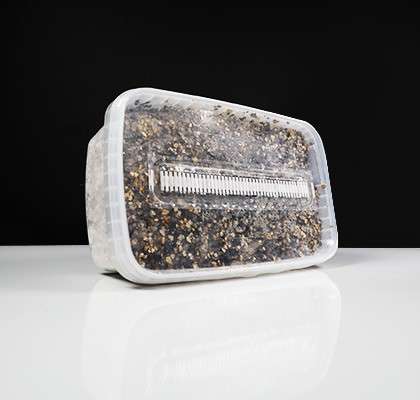
A grow kit removes the most failure-prone step in cultivation — the sterile inoculation of substrate with spores — by delivering a substrate that is already fully colonised with healthy Golden Teacher mycelium. From the moment you open it, the work the kit asks of you is small: hydrate the substrate, place it inside the included grow bag with paper-clip closures, keep it at room temperature, and check on it once a day.
From a single 1200 cc Golden Teacher kit, growers commonly harvest 350 to 500 grammes of fresh mushrooms across three to four flushes, with the second flush often outperforming the first. Smaller 250 cc kits typically yield around 100 grammes per flush — perfect for someone who wants to try cultivation without committing to a large harvest.
At Mindrush.eu, we ship Golden Teacher grow kits discreetly from the Netherlands across most EU countries, in fully neutral packaging with no visible product details on the outside. The kits are produced under Dutch law, contain only pre-colonised substrate (no mature mushrooms or extracted alkaloids at the time of sale), and arrive with clear instructions plus access to our digital growing guide. We also stock fresh magic truffles and microdosing sets for customers who prefer not to cultivate at all.
A few honest notes worth flagging: it is the customer’s responsibility to verify the legality of grow kits in their own country before ordering, because rules vary widely across the EU. Mindrush sells products that comply with Dutch law and ships within the EU under Regulation 2019/515, but cannot guarantee customs treatment in every jurisdiction.
14. Frequently Asked Questions
How long does it take to grow Golden Teacher from a grow kit?
From opening a pre-colonised kit to first harvest is typically 14 to 21 days, depending on room temperature. Subsequent flushes appear roughly every 7 to 10 days after a successful cold-shock between flushes.
Are Golden Teacher mushrooms suitable for first-timers?
Yes — it is the strain most commonly recommended to first-time users by experienced psychonauts and harm-reduction organisations. Its moderate potency makes it forgiving, while its introspective character tends to produce meaningful rather than overwhelming experiences. That said, dosage matters far more than strain choice. A 4-gram dose of Golden Teacher is more intense than a 0.5-gram dose of Penis Envy.
Can I overdose on Golden Teacher mushrooms?
Lethal physical overdose is extraordinarily unlikely; psilocybin has one of the highest therapeutic indices of any psychoactive substance studied. The realistic risks are psychological — overwhelming anxiety, panic, or a difficult experience — and indirect risks like injuring oneself by acting unsafely while disoriented. Both are managed with appropriate dosing, set, setting, and a sober sitter.
How should I store dried Golden Teacher mushrooms?
Once thoroughly dried to cracker-dryness, store in an airtight glass jar with a desiccant packet, in a cool, dark place. Properly dried and stored mushrooms retain their potency for a year or more. Light, heat, and moisture all degrade psilocybin over time.
Is Golden Teacher legal where I live?
That depends entirely on your jurisdiction. The mushrooms themselves are illegal in most countries. Spores are legal in much of Europe (and many US states) because they contain no psilocybin. Grow kits sit in a more variable legal grey zone. Always check your local laws before ordering anything.
How does microdosing Golden Teacher work?
A typical protocol uses 0.05–0.2 g of dried Golden Teacher every third day (sometimes called the Fadiman protocol), with the goal of staying below the perceptual threshold while supporting mood, focus, and creativity. Tolerance to psilocybin builds quickly, so taking days off is essential. Most credible long-term microdosing reports come from people who treat it as a focused 4–8 week experiment rather than indefinite daily use.
15. Final Thoughts
Golden Teacher’s enduring popularity is not a marketing accident. It is the result of forty years during which a single strain has consistently delivered three things that almost no other variety can match all at once: a beautiful, photogenic mushroom; a forgiving cultivation profile; and a psychedelic experience that most people find emotionally meaningful rather than overwhelming.
Whether you are coming to this strain through a clinical research lens, a microdosing curiosity, a spiritual interest, or simply a fascination with mycology, the practical advice is the same: respect the substance, start lower than you think you need, prioritise set and setting, and treat each experience as something to learn from rather than something to chase.
If you decide to grow your own, Mindrush’s Golden Teacher grow kits are produced in the Netherlands, shipped discreetly across the EU, and supported by clear written instructions. If you’d rather skip cultivation entirely, our magic truffles deliver a similar (though milder) experience without the wait — and remain fully legal under Dutch law.
Either way: the Golden Teacher has earned its name. Whatever it ends up teaching you, may the lesson be a good one.
Disclaimer
This article is for informational and educational purposes only. It is not medical, legal, or psychological advice. Psilocybin and psilocin are controlled substances in many countries. The legal status of mushrooms, spores, mycelium, and grow kits varies by jurisdiction; readers are responsible for verifying the laws that apply to them. Mindrush only sells products that are legal under Dutch law and intended for adult customers (18+).