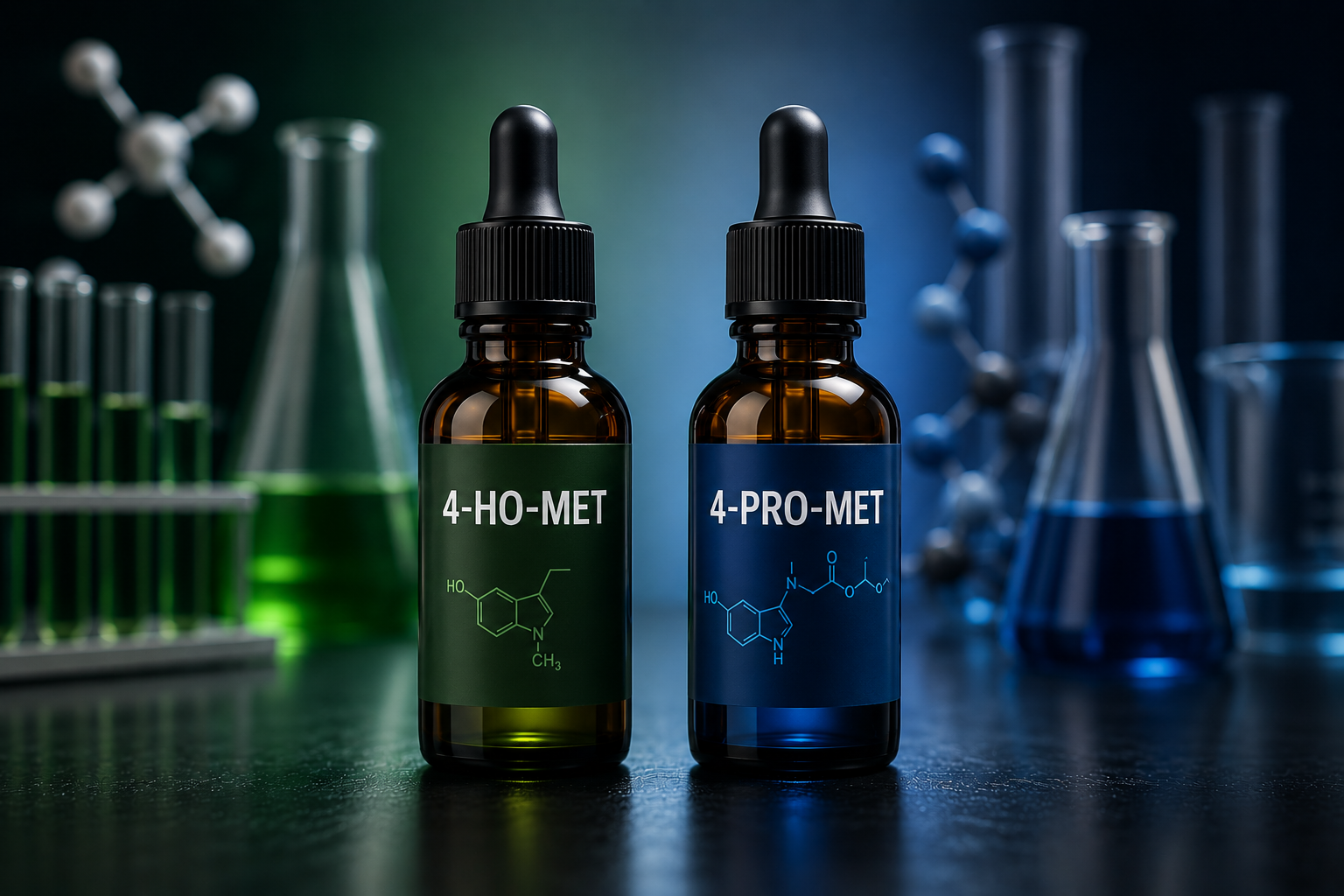
We get a lot of questions about how 4-HO-MET and 4-PRO-MET compare. They show up in the same conversations, especially in relation to us mushroom drops, and people want to know how the two compounds relate. This is especially true now that 4-PRO-MET can be shipped to more European countries than 4-HO-MET.
This article explains what each compound is, how they're connected, and why the rules around them differ from country to country
Important: Both compounds are sold for laboratory and research use only. Nothing in this article is advice for personal use. There's a fuller safety section at the end.
Quick summary
In a hurry? Here are the key points:
- They're closely related. 4-PRO-MET is a slightly modified version of 4-HO-MET. The body converts 4-PRO-MET into 4-HO-MET, which makes 4-PRO-MET a “prodrug.”
- The molecules are almost identical. They differ on one small spot. 4-PRO-MET has a “protective cap” that 4-HO-MET doesn't have.
- 4-PRO-MET likely stays more stable in storage, because that cap protects the reactive part of the molecule.
- Reported effects overlap a lot. Anecdotal reports (not scientific studies) describe 4-HO-MET as fast-acting and visually intense, while 4-PRO-MET tends to come on more gradually. Since one turns into the other in the body, users report a similar overall experience.
- Legal availability is the biggest practical difference. Several European countries name 4-HO-MET in their drug laws. 4-PRO-MET often doesn't appear on those lists yet. That's why we can ship 4-PRO-MET to more countries right now.
- Research data on both is very limited. Scientists haven't properly studied safety, dosing, or interactions.
- Always check local laws before ordering. Rules change often and vary by country.
The rest of the article goes into the details.
What are 4-HO-MET vs 4-PRO-MET?
Both belong to a group of chemicals called tryptamines. They're related to psilocin, which is the active part of psilocybin mushrooms and magic truffles.
4-HO-MET (Metocin)
4-HO-MET (also called metocin) was first described by chemist Alexander Shulgin in the 1980s. It's one of the better-known psilocin-like research chemicals. There's very little formal research on it in humans. Most of what you'll read online comes from forum posts and personal reports, not scientific studies. That's worth keeping in mind. You can read more about 4-HO-MET on Wikipedia.
4-PRO-MET (4-PrO-MET)
4-PRO-MET is newer. It started appearing on the European market over the past year.
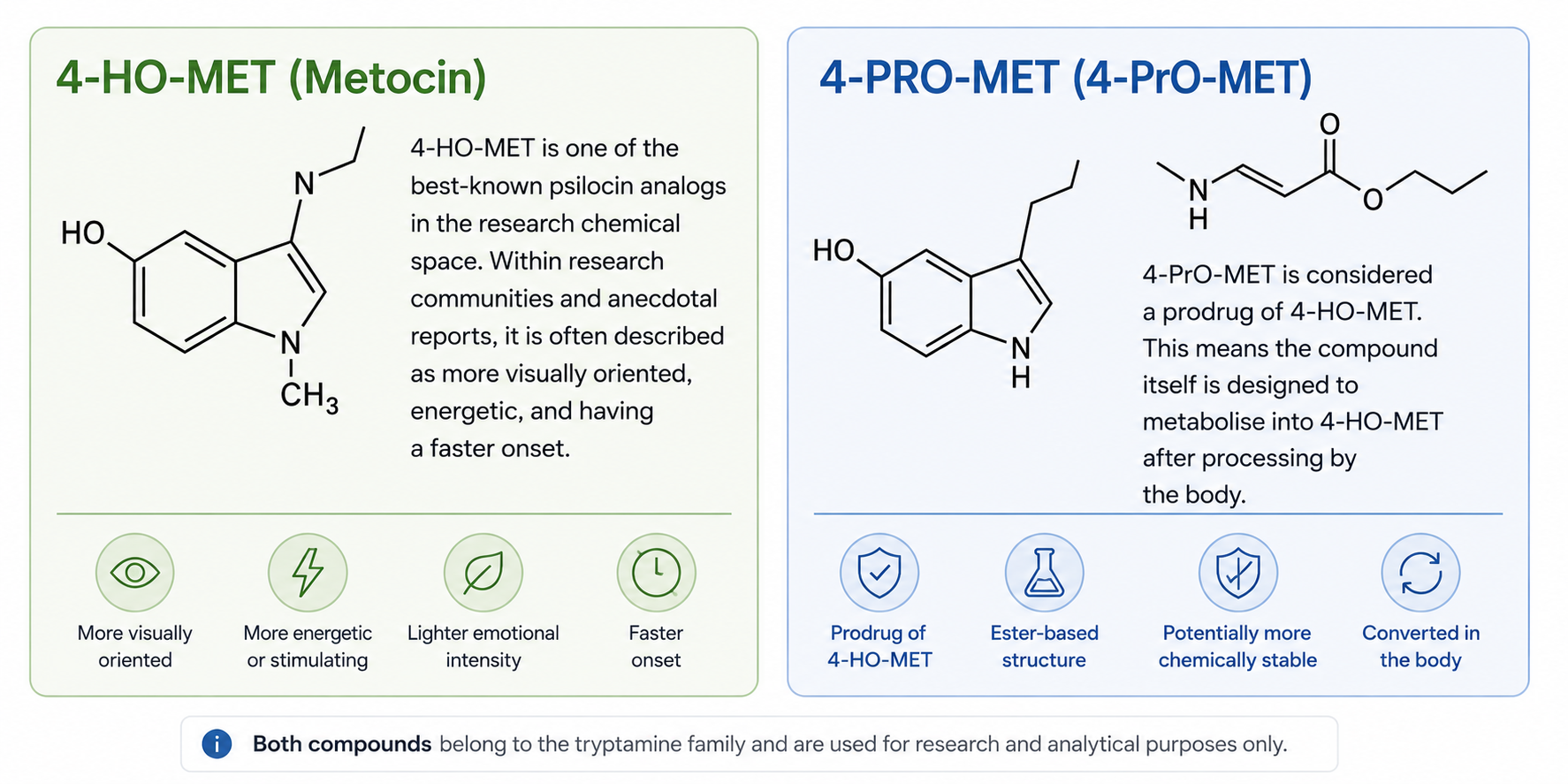
The molecule is almost the same as 4-HO-MET, with one small change. A “propionyl ester” group is attached where 4-HO-MET has a plain hydroxyl group. The expectation is that the body breaks off this ester and turns 4-PRO-MET into 4-HO-MET. That would make 4-PRO-MET a “prodrug” of 4-HO-MET.
- 4-HO-MET = the active compound itself
- 4-PRO-MET = a modified version that converts into 4-HO-MET through hydrolysis
This is similar to how psilocybin turns into psilocin in the body, or how 4-AcO-DMT turns into psilocin.
To be clear: this is what chemists expect based on the structure. It hasn't been confirmed by published studies in humans. We don't know exactly how complete the conversion is, or how fast it happens.
The main differences between 4-HO-MET vs 4-PRO-MET
1. Legal availability in Europe
This is currently the biggest practical difference for most customers.
Certain European countries introduced legislation that specifically affected compounds such as 4-HO-MET, while newer analogs like 4-PRO-MET may not yet be explicitly listed under local laws.
That is why some vendors, including us, can currently ship 4-PRO-MET to more European destinations than 4-HO-MET.
Always check the rules in your own country before ordering. We can't do that for you, and customs seizures and prosecutions do happen. You can also read more about our general approach on our legality page.
2. The molecule itself
Imagine the molecule as a small structure with a few “arms” sticking out. 4-HO-MET and 4-PRO-MET are almost identical. They only differ on one of those arms.
On 4-HO-MET, that arm ends in a small group called a hydroxyl group (written as –OH). It's a simple combination of one oxygen and one hydrogen atom. This is the “active” part of the molecule. It's also the part that's a bit fragile and reacts easily with air, light, and moisture.
On 4-PRO-MET, that same arm has something extra attached to it: a propionyl ester group. You can think of this as a small “cap” placed over the hydroxyl group. The cap protects it.
Once 4-PRO-MET enters the body, the cap is expected to come off. What's left behind is 4-HO-MET, the active compound. This is why 4-PRO-MET is called a “prodrug”: it's not active itself, but it turns into something that is.
A useful comparison: it's a bit like the difference between psilocybin and psilocin in mushrooms. Psilocybin also has a small “cap” (a phosphate group) that comes off in the body, leaving psilocin, which is the active part. The principle is the same here, just with a different cap.
3. Stability
4-HO-MET is sensitive to air, light, and moisture. Like psilocin, it can break down over time when stored badly.
Ester compounds like 4-PRO-MET are generally expected to be more stable, because the ester “protects” the reactive part of the molecule until it's broken down later. This is a chemical expectation, not something that's been carefully measured and compared for these two specific compounds.
4. Reported effects
There's no proper clinical research comparing these two in humans. What's online is anecdotal: personal reports from forums. These are unreliable for all the usual reasons. People don't always know the real dose, the purity isn't checked, and people remember things selectively.
With that warning in mind, the reports usually describe:
- 4-HO-MET as fast onset, visually intense, Energetic and colorful.
- 4-PRO-WITH as a bit slower to come on. That fits the prodrug idea, since the body needs time to convert it but has a similar visual profile.
People also report a lot of overlap between the two, which again fits the idea that one turns into the other.
Treat these descriptions as starting points for research, not as proven facts.
4-HO-MET vs 4-PRO-MET: which one is right for research?
It depends on what you're studying.
4-HO-MET makes more sense if you want to look at the active compound itself. For example, for analytical reference work, or to compare with the existing literature on psilocin analogs (which is bigger for 4-HO-MET).
4-PRO-WITH makes more sense if you're specifically interested in ester prodrugs, how stable they are, or how they break down.
In practice, many people just pick whichever one is legal where they live. That's understandable, but it isn't really a research reason.
Frequently Asked Questions
Is 4-PRO-MET legal in my country?
We can't answer that for you. Drug laws differ from country to country, and they often change. Some countries have specific lists of banned compounds, others use broader rules that can cover whole groups of similar chemicals. Always check the current rules in your own country before ordering. A national drug information service or a legal professional is a more reliable source than a vendor.
Is 4-PRO-MET the same as 4-HO-MET?
Not exactly. They're closely related but chemically different. 4-PRO-MET is expected to turn into 4-HO-MET inside the body, but until that conversion happens, they're separate compounds with different stability and different legal status.
Is 4-PRO-MET stronger or weaker than 4-HO-MET?
There's no reliable scientific data that compares them directly in humans. Since 4-PRO-MET is thought to convert into 4-HO-MET, the active compound ends up being the same. The amount of 4-PRO-MET needed to produce a given amount of 4-HO-MET in the body isn't precisely known.
Why does 4-PRO-MET take longer to take effect?
The body needs time to break off the “ester cap” and turn 4-PRO-MET into 4-HO-MET. That extra step is why anecdotal reports describe a more gradual onset compared to 4-HO-MET.
How should these compounds be stored?
For research purposes, both are best kept cool, dry, and out of direct light. 4-HO-MET is more sensitive to air and light than 4-PRO-MET, so airtight, opaque containers in a cool place are especially important for 4-HO-MET. Long-term storage in a freezer is common practice for sensitive tryptamines.
Are there interactions with medications?
The specific interactions for 4-HO-MET and 4-PRO-MET haven't been studied, but tryptamines as a group can interact dangerously with many medications. Antidepressants (SSRIs and especially MAOIs), lithium, tramadol, and some migraine medications are known concerns for related compounds. This is one of the reasons these compounds aren't suitable for human use without proper medical research.
Final Thoughts
4-HO-MET and 4-PRO-MET sit close together on the chemical map. They share most of their structure, and the body converts one into the other. For most practical purposes, they belong to the same family of research compounds.
The differences that actually matter are on the surface. 4-PRO-MET is the newer of the two, likely more stable in storage, and currently easier to ship to more European countries. 4-HO-MET has a longer history in the research literature and a larger base of existing reports, but tighter legal restrictions in several places.
What both compounds have in common is how little we properly know about them. There's no large body of clinical research, no established safety profile, and no standard for purity outside of independent lab testing. The “research chemical” label is accurate, but you should take it seriously: scientists haven't studied these compounds the way they study medicines, and treating them otherwise is genuinely risky.
If you're working with either compound in a research context, the most useful things you can do are simple ones. Verify the legal status in your own country. Get independent purity testing where possible. Store the material properly. And don't lean on forum reports as if they were data.
The science around novel tryptamines is moving slowly, but it is moving. Hopefully the gap between what's available on the market and what we actually understand about these compounds will narrow over time.
Disclaimer
All compounds mentioned in this article are:
• Sold strictly for research and analytical purposes
• Not approved for human consumption
• Not intended to diagnose, treat, or prevent any disease
• Not sufficiently studied for long-term safety
Scientific research on many novel tryptamines remains limited, and legal status can change rapidly across Europe.