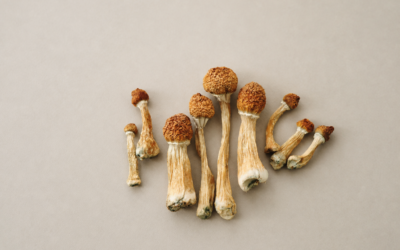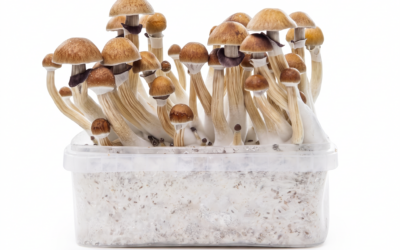
We get a lot of questions about what's actually inside magic truffles and magic mushrooms. Two names come up again and again: psilocybin and psilocin. People often use them as if they're the same thing, or assume one is just a typo of the other. They're not. They're two different molecules, and the relationship between them explains almost everything about how truffles work, why they're dosed the way they are, and why storage matters so much.
This article explains what each compound is, how they're connected, and why the difference is more than just a technical detail. It's the same kind of deep-dive we did for 4-HO-MET vs 4-PRO-MET and as you'll see, the underlying principle is remarkably similar.
Important: This article is educational. Nothing here is medical advice or a recommendation for personal use.
Quick summary
In a hurry? Here are the key points:
- They're closely related. Psilocybin is a slightly modified version of psilocin. The body converts psilocybin into psilocin, which makes psilocybin a “prodrug.”
- The molecules are almost identical. They differ on one small spot. Psilocybin has a “protective cap” (a phosphate group) that psilocin doesn't have.
- Psilocin is the active one. It's the molecule that actually produces the psychedelic effect by binding to serotonin receptors in the brain. Psilocybin itself does very little until your body strips off that cap.
- Psilocybin is far more stable in storage, because the phosphate cap protects the reactive part of the molecule. Psilocin breaks down quickly when exposed to air, light, and warmth. This is what causes the famous “bluing” reaction.
- Both occur naturally in magic truffles and magic mushrooms, usually with much more psilocybin than psilocin.
- The science is well established here, unlike many newer research chemicals. Psilocybin's conversion to psilocin has been studied in humans for decades.
The rest of the article goes into the details.
What are psilocybin and psilocin?
Both belong to a group of chemicals called tryptamines, the same family as the research compounds we covered in our 4-HO-MET vs 4-PRO-MET article. They're also structurally close to serotonin, the brain's own neurotransmitter, which is a big part of why they do what they do.
These are the two main active compounds in it magic truffles and magic mushrooms. If you've read our complete guide to psilocybin sclerotia, you've already met them both.
Psilocybin
Psilocybin (chemically, 4-phosphoryloxy-N,N-dimethyltryptamine) was first isolated and named by the Swiss chemist Albert Hofmann in 1958. The same chemist behind LSD. It's the compound that gets the most attention in research papers and headlines, and it's usually the most abundant tryptamine in fresh truffles and mushrooms.
Here's the catch: psilocybin is not actually the molecule that affects your brain. On its own it's largely inactive. It owes its entire reputation to what it turns into. You can read more about psilocybin on Wikipedia.
Psilocin
Psilocin (4-hydroxy-N,N-dimethyltryptamine, sometimes written 4-HO-DMT) is the active one. It's the compound that crosses into the brain and binds to serotonin receptors, producing the psychedelic experience.
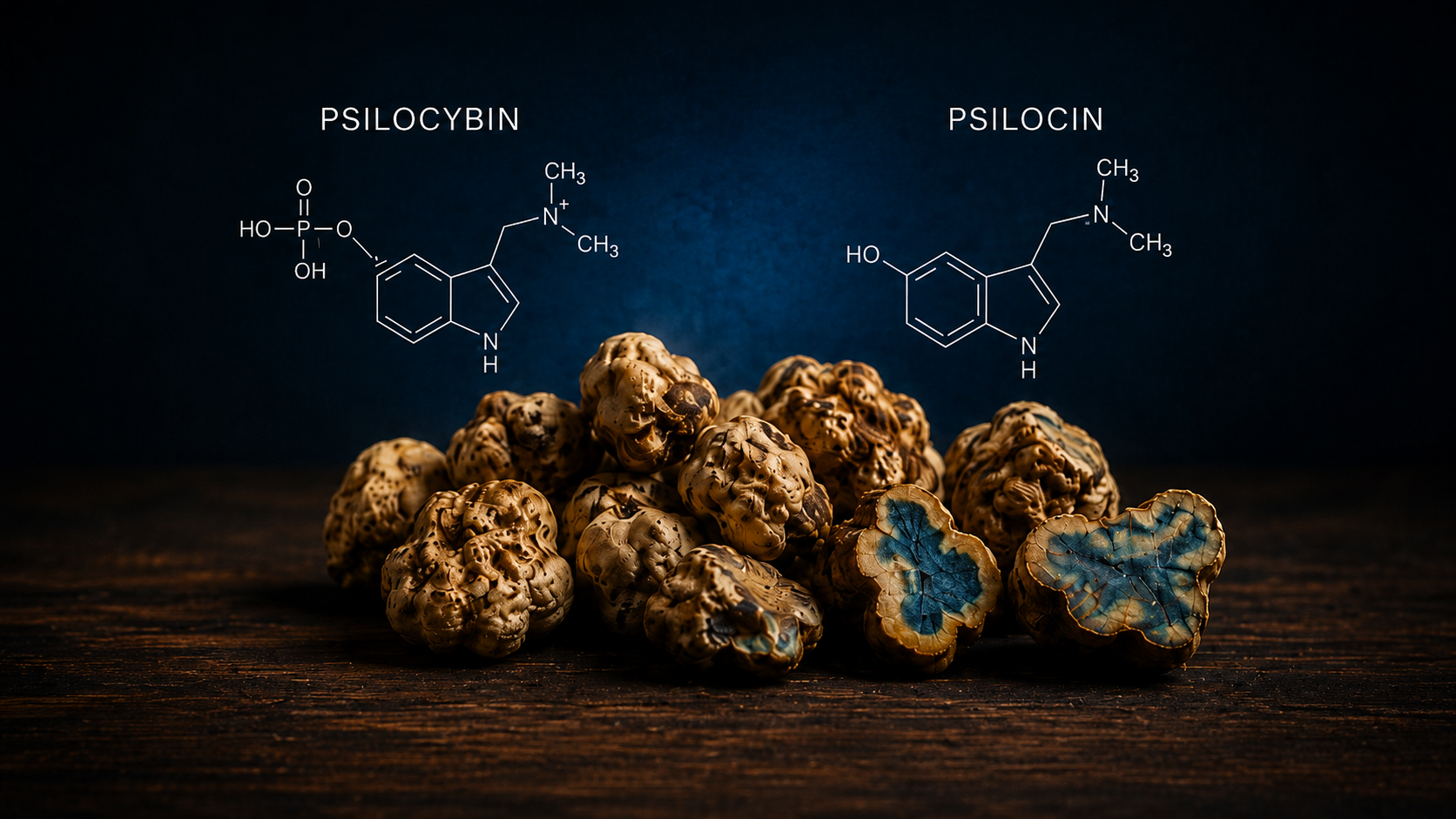
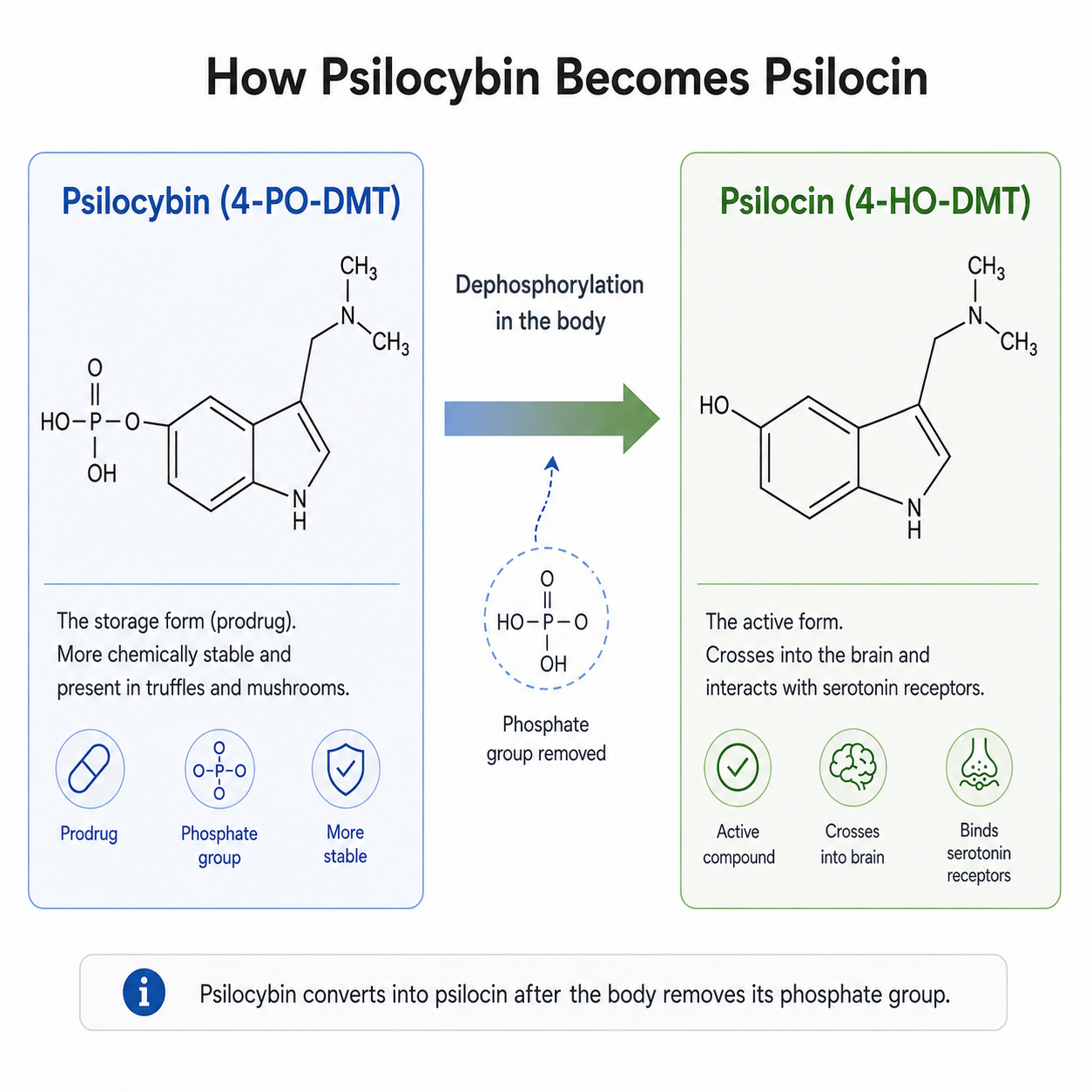
The molecule is almost the same as psilocybin, with one small change. Where psilocin has a plain hydroxyl group, psilocybin has a phosphate group attached in its place. Your body breaks off that phosphate and turns psilocybin into psilocin, a process called dephosphorylation.
- Psilocybin = the storage form, a “prodrug” that converts into psilocin
- Psilocin = the active compound itself
To be clear about the direction here: psilocybin is the one with the extra group, and it converts into psilocin. You can read more about psilocin on Wikipedia.
This is exactly the same principle we described with 4-PRO-MET converting into 4-HO-MET, or 4-AcO-DMT converting into psilocin. Different “cap,” same idea.
The main differences between psilocybin and psilocin
1. The molecule itself
Imagine the molecule as a small structure with a few “arms” sticking out. Psilocybin and psilocin are almost identical. They only differ on one of those arms.
On psilocin, that arm ends in a small hydroxyl group (written as –OH) — one oxygen and one hydrogen atom. This is the “active” part of the molecule. It's also the part that's a bit fragile and reacts easily with air, light, and moisture.
On psilocybin, that same arm has something extra attached: a phosphate group. You can think of this as a small “cap” placed over the hydroxyl group. The cap stabilizes the molecule and protects that reactive spot.
Once psilocybin enters the body, the cap comes off. What's left behind is psilocin, the active compound. This is why psilocybin is called a “prodrug”: it's not really active itself, but it reliably turns into something that is.
It's a useful comparison to keep in mind for any tryptamine: the active part is almost always that exposed –OH group, and the various “research chemicals” and natural compounds in this family mostly differ by what cap (if any) is sitting on top of it.
2. Which one is active: psilocybin or psilocin?
This is the difference that matters most.
Psilocin is the molecule that does the work. It's structurally similar to serotonin, and it acts as an agonist (and partial agonist) at serotonin receptors in the brain — most importantly the 5-HT2A receptor. That receptor activity is what's responsible for the changes in perception, mood, and thought that define the psychedelic experience.
Psilocybin barely binds to those receptors at all. When you consume truffles, the psilocybin in them isn't what reaches your brain. Your body has to convert it first. The phosphate cap is stripped off — partly in the acidic environment of the stomach, and largely by enzymes called alkaline phosphatases in the intestine, kidneys, and liver. Only then does psilocin enter the bloodstream and cross into the brain.
In practice this conversion is fast and fairly complete, which is why, in equivalent amounts, psilocybin and psilocin produce very similar effects. The difference is mechanical: psilocybin is the delivery vehicle, psilocin is the payload.
3. Stability and the “bluing” reaction
Here's where the cap really earns its keep.
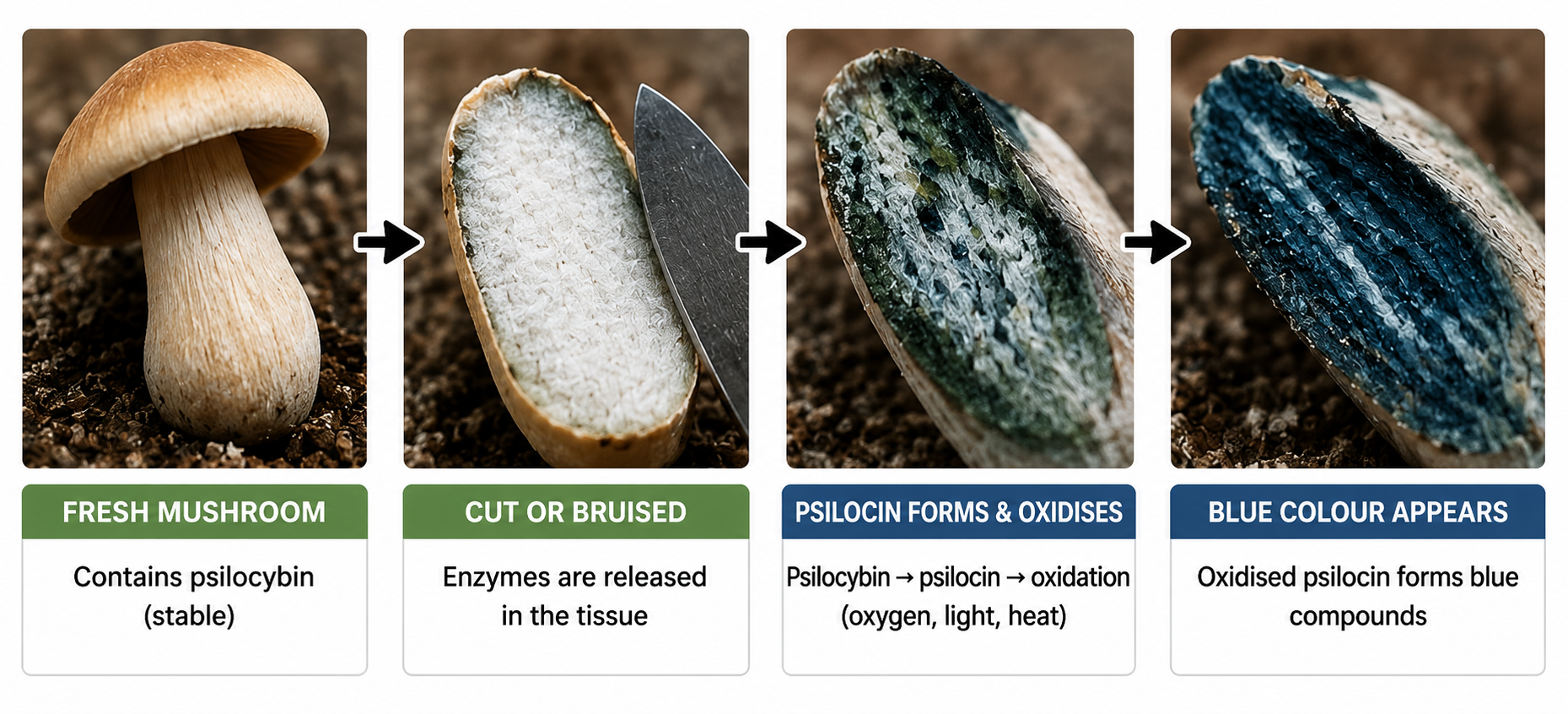
Psilocin is unstable. That exposed hydroxyl group reacts readily with oxygen, and it's sensitive to light and heat. When psilocin oxidises, it forms blue-colored compounds. This is the well known bluing reaction you see when fresh mushrooms or truffles are cut or bruised: enzymes convert psilocybin to psilocin, the psilocin oxidises, and the tissue turns blue.
That blue color is often misread as a sign of potency. It's closer to the opposite — it signals that active compound is demotion, not concentrating. (Researchers at the Leibniz Institute identified the exact enzymes and blue pigments behind this reaction in 2019.)
Psilocybin is far more stable. The phosphate cap shields the reactive spot, so psilocybin holds up much better in storage than psilocin does. This is the natural version of the same trick chemists use deliberately with ester prodrugs like 4-PRO-MET.
This is the single most practical takeaway of the whole article, and it's why storage matters so much. Warmth, light, air, and moisture all accelerate the breakdown of psilocin and the conversion-then-oxidation of psilocybin. If you want the chemistry to stay where you want it, the rules are simple: cool, dark, dry, airtight. We go through this in detail How to Store Magic Truffles, and it's also a big part of why fresh and dried mushrooms differ in how they're handled.
4. Onset and duration
Because psilocybin has to be converted before anything happens, there's a built-in delay between taking it and feeling it. That conversion step is part of why effects come on gradually rather than instantly, and it contributes to the overall timeline of a truffle experience.
Once psilocin is in circulation, blood levels typically peak within roughly two hours, with the core experience lasting several hours before tapering off. If you want the full picture of how a session unfolds from start to finish, we cover it in How Long Do Magic Truffles Last?.
5. Where they're found and in what ratio
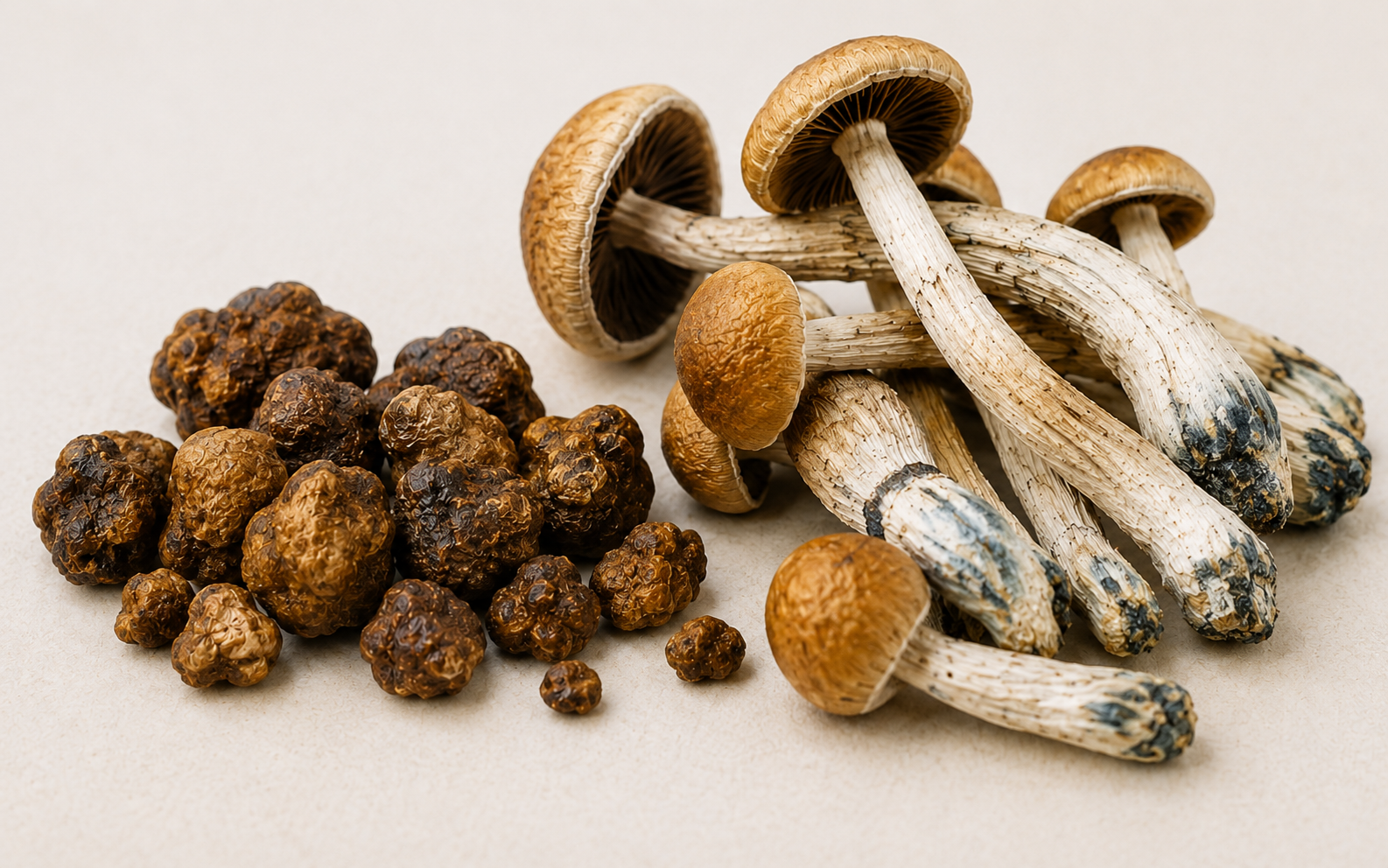
Both compounds occur together naturally Psilocybe truffles and mushrooms, but rarely in equal amounts. Fresh material usually contains considerably more psilocybin than psilocin, because the plant stores the stable “capped” form and only converts it to psilocin when the tissue is damaged or starts to break down.
This ratio shifts over time and with handling — another reason storage conditions affect not just how much active compound survives, but the balance between the two forms. It's also why total potency varies between products and batches, and why our dosage guide emphasises starting low and adjusting.
Why the psilocybin vs psilocin difference matters for truffles
For everyday purposes, you don't need to track psilocybin and psilocin separately. Your body handles the conversion for you. But understanding the relationship clears up a lot of common confusion:
- “Total psilocybin” figures can be misleading. A lab number for psilocybin tells you the potential, but real-world potency depends on how much survives storage and how much has already converted (and possibly degraded) into psilocin.
- Bluing isn't a strength meter. A little blue on sparkled truffles is normal. Heavy discolouration points to degradation, not extra power.
- Storage is everything. Because psilocin is the fragile one and psilocybin is the stable one, keeping your truffles cool, dark, and sealed protects both the amount and the balance of active compound. This applies equally whether you're dosing for a full experience or microdosing, where consistency between doses really matters.
- It explains the prodrug pattern across the whole family. Once you understand psilocybin → psilocin, the logic behind compounds like 4-AcO-DMT, 4-PRO-MET, and others in our mushroom drops range Makes immediate sense.
If you're new to all of this, ours magic truffles explained guide is the best place to start, and the magic truffles category shows the range we ship across Europe.
Frequently Asked Questions
What is the difference between psilocybin and psilocin?
Psilocybin is a prodrug: it's the stable form found in truffles and mushrooms, but it isn't very active on its own. Your body converts psilocybin into psilocin, which is the active compound that binds to serotonin receptors and produces the psychedelic effect. So psilocybin is essentially the “delivery” form, and psilocin is the form that actually does the work. They differ chemically by a single phosphate group.
Is psilocin stronger than psilocybin?
By weight, yes. But that's a bit of a trick answer. Psilocin is the active compound, so a given amount of pure psilocin has more direct effect than the same weight of psilocybin (some of which is “wasted” on the phosphate cap that gets removed). In practice, though, your body converts psilocybin into psilocin efficiently, so equivalent amounts produce very similar experiences. The difference is mostly about the molecule, not the strength of the trip.
Is psilocybin the same as psilocin?
No. They're closely related but chemically different. Psilocybin converts into psilocin inside your body. Until that conversion happens, they're separate molecules with different stability and different roles. Psilocybin is the stable storage form, psilocin is the active form.
Why do truffles turn blue when I cut or bruise them?
That's the blinding reaction. Damaging the tissue triggers enzymes that convert psilocybin to psilocin, and the psilocin then oxidises into blue pigments. A little is completely normal. A lot usually signals that active compound is breaking down. So it's a sign to check your storage, not a sign of extra potency.
Which compound should I care about for potency?
Both, but for different reasons. Psilocybin is usually the larger, more stable reserve; Psilocin is the active form your body ultimately uses. Total potency depends on how much of both survives in your truffles, which comes back to freshness and storage.
How should I store truffles to protect these compounds?
Cool, dark, dry, and airtight. Psilocin is sensitive to air, light, and warmth, and even psilocybin will slowly convert and degrade under poor conditions. Refrigeration is fine for short-term fresh storage; for the full breakdown see our storage guide.
Final Thoughts
Psilocybin and psilocin sit right next to each other on the chemical map. They share almost their entire structure, and your body turns one into the other. For most practical purposes, they're two faces of the same thing.
But the small difference between them, a single phosphate cap, explains a surprising amount. It's why psilocybin is the stable form that plants store and labs measure, and why psilocin is the fragile, active form that actually reaches your brain. It's why truffles turn blue when bruised, why storage conditions matter so much, and why a “total psilocybin” number on its own doesn't tell the whole story.
Unlike many of the newer compounds in this space, the psilocybin–psilocin relationship remains on decades of solid research. The chemistry is genuinely well understood. What still varies and what's within your control is how well the active compound is preserved between harvest and use. Keep your truffles cool, dark, dry, and sealed, and you protect both the amount and the balance of what makes them work.
If you want to go deeper, the further reading below ties this chemistry back to the practical side: choosing, dosing, and storing your truffles.
Disclaimer
The information in this article is provided for educational purposes only. Our products are not intended to diagnose, treat, cure, or prevent any disease, and should not be considered a substitute for professional medical advice. Always check the legal status of any product in your own country before ordering you can see our legality page for our general approach.
Further reading
- Magic Truffles: The Complete Guide to Psilocybin Sclerotia
- Magic Truffles Explained: What They Are and Why They're Legal
- Magic Mushrooms vs Magic Truffles: What Is the Real Difference?
- How to Store Magic Truffles – Complete Guide
- How Long Do Magic Truffles Last? Duration & Effects
- Magic Truffle Dosage Guide – From Beginner to Experienced
- 4-HO-MET vs 4-PRO-MET: What Is the Difference?
- Mushroom drops product range