It's the question almost everyone asks before their first time: what does a magic truffle trip actually feel like? It's a hard thing to put into words, partly because the experience is so different from ordinary consciousness, and partly because it actually varies from person to person and session to session. But that doesn't mean we can't describe it honestly.
This guide walks you through what a magic truffle experience really feels like — phase by phase, across the senses, the emotions, and the mind. We'll be honest about the beautiful parts and the challenging parts, explain how dose and setting shape everything, and give you a realistic picture rather than either hype or fear. Whether you're curious, nervous, or preparing for your first experience, this is the straight answer.
The honest short version A magic truffle trip feels like the ordinary filters on your perception loosening. Colors brighten, thoughts connect in new ways, emotions surface more freely, and your sense of time and self softens. At lower doses it's gentle and dreamlike; at higher doses it can be profound and overwhelming. It's not like being drunk or high — it's more like seeing the familiar world with completely fresh eyes.
Why It's So Hard to Describe
Part of what makes a truffle experience difficult to put into words is that it changes the very thing you'd use to describe it: your mind. Language is built for ordinary, everyday consciousness. A psychedelic experience often takes you somewhere language wasn't designed to map.
That's why people who've tried it so often fall back on “you just have to experience it” — not because they're being mysterious, but because the experience genuinely sits outside normal categories. Still, certain themes come up again and again across thousands of accounts, and those themes give us a reliable picture of what to actually expect.
The Phases of a Magic Truffle Trip
A typical truffle experience moves through recognizable phases. Knowing them in advance makes the whole thing far less intimidating, because you understand what's happening and that each phase passes.
The come-up (30–60 minutes in)
The first sign is usually subtle. A lightness, a slight tingling in the body, a faint sense that something is shifting. Colors may start to look a little more vivid, edges a little more defined. Some people feel a flutter of nervous anticipation here, occasionally with mild nausea or yawning as the body adjusts. This phase can feel slightly uncertain — you're aware it's beginning but not yet sure where it's going. That's completely normal.
The come-up deepens (60–90 minutes)
Now it builds. Visual changes become clearer — surfaces may seem to gently breathe or ripple, patterns emerge in textures, colors take on a glow. Thoughts begin to flow differently, connecting in unexpected ways. Music starts to feel three-dimensional, almost physical. Many people feel waves of emotion or spontaneous laughter here. The uncertainty of the early come-up usually gives way to a sense of “oh, here we go.”
The peak (roughly 2 hours in, lasting 60–90 minutes)
This is the heart of the experience. At a moderate dose, the peak feels like being fully immersed in a richer version of reality — frame senses, flowing thoughts, deep appreciation of beauty, strong emotional currents. At higher doses, the peak can become truly profound: the boundary between you and the world may soften, time can seem to stop or loop, and you may have insights that feel deeply meaningful. It's intense but, in the right setting, usually beautiful.
The comedown (3–4 hours in)
The intensity gradually recedes. You begin to feel more like yourself, though still gently altered. This phase is often calm and reflective — many people find it the most pleasant part, a soft landing where the insights of the peak settle into place. Emotions tend to feel open and warm.
The afterglow from the Magic truffle trip (the next hours to days)
After the experience proper ends, many people report an afterglow: a lingering sense of calm, openness, gratitude, or clarity that can last from the rest of the evening to several days. Colors may still seem a little brighter, problems a little smaller. This afterglow is one of the most cherished parts of the experience for regular users.
What the Magic truffle trip Feels Like, Sense by Sense
Beyond the timeline, it helps to break the experience down into the different dimensions people notice.
Visually
Colors become richer and more saturated. Surfaces and patterns may seem to move, breathe, or shift gently. With eyes closed, many people see flowing geometric patterns, colors, or dreamlike imagery. Truffle visuals tend to be softer and more organic than the sharp, electric visuals of some other psychedelics — more like a living watercolor than a screensaver.
Mentally
Thoughts flow more freely and connect in new ways. You may find yourself understanding something about your life, a relationship, or a problem from a completely fresh angle. Mental chatter often quietens, replaced by a kind of spacious clarity. Creativity tends to flow. Time perception loosens — minutes can feel like hours, and hours can vanish.
Emotionally
This is often the most significant dimension. Emotions surface more freely and are felt more fully. For most people in a good setting, this means warmth, joy, connection, awe, and laughter. Sometimes older or buried emotions surface too, which can bring tears — often in a cathartic, healing way rather than a distressing one. The emotional openness is a big part of why people describe truffle experiences as meaningful rather than just fun.
Physically
Bodily sensations vary. Common ones include a pleasant tingling or energy, temperature sensitivity to touch and temperature, and a feeling of lightness. The come-up can bring mild nausea or restlessness that settles once the peak arrives. Many people feel an urge to move, stretch, or be in nature; others prefer to lie still and turn inward.
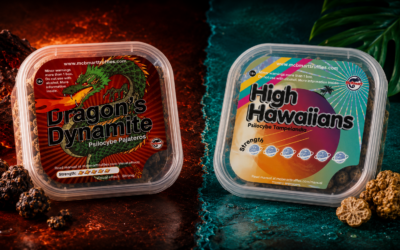
Curious to experience it yourself? If you're new and want the gentlest introduction, our milder truffles like Pink Paradise and Atlantis are the place to start. Grown fresh in the Netherlands, shipped discreetly across the EU. Use code FOREVER10 for 10% off your first order.
How the Dose Changes the Experience
Dose is the single biggest factor in how a truffle trip feels. The same person can have radically different experiences depending on how much they take.
Microdose (0.5–1.5 g fresh)
Sub-perceptual. You don't “trip” at all. Instead, many people report a subtle lift in mood, focus, or creativity — a slightly brighter, more present version of an ordinary day. No visuals, no altered perception. If you feel clearly altered, it's not a microdose.
Light dose (5–10 g fresh)
A gentle experience. Noticeable but very manageable: warmer mood, gentle visual enhancement, music sounding richer, a pleasant sense of flow. This is the ideal first-time territory — enough to clearly understand what truffles do, without being overwhelmed.
Moderate dose (10–15 g fresh)
A full psychedelic experience. Clear visuals, significant shifts in thought and emotion, time distortion, deep immersion. This is where most of the classic “trip” descriptions come from. Best once you already know how truffles affect you.
Strong dose (15+ g fresh)
Intense and potentially profound. Can include powerful visuals, deep emotional content, and at the higher end, ego dissolution — the temporary loss of the normal sense of being a separate self. This can be one of the most meaningful experiences of a person's life, but it can also be overwhelming, and it's strictly for experienced users with proper preparation and a sober sitter.
For a complete dose-by-dose breakdown, see our magic truffle dosage guide.
Why Set and Setting Shape Everything
Two people can take the exact same dose of the exact same truffle and have completely different experiences. The difference usually comes down to “set and setting” — your mindset going in, and your environment during.
Set is your inner state: your mood, your expectations, your emotional baggage that day, how safe and relaxed you feel. Going in anxious or fearful tendencies to color the whole experience. Going in calm, curious, and open tends to lead somewhere good.
Setting is your environment: where you are, who you're with, the lighting, the sounds, whether you feel safe and unhurried. A calm, familiar, comfortable space with someone you trust is the foundation of a good experience.
Getting these right is the difference between a beautiful experience and a difficult one. Our guide on how to use magic truffles responsibly covers how to prepare both properly.

What About a Difficult Magic Truffle Trip?
It would be dishonest to describe only the beautiful side. Sometimes a truffle experience becomes challenging — anxiety, confronting emotions, a feeling of losing control, or uncomfortable thoughts. This is more likely at higher doses, in a poor setting, or when going in with an anxious mindset.
The important thing to understand: difficult moments are almost always temporary and manageable, and they often carry the most valuable insights once you're through them. A few things that help:
- Remember it will pass. The peak lasts 60–90 minutes. The intensity always recedes. Reminding yourself of this can dissolve anxiety on its own.
- Don't fight it. Resisting difficult feelings usually amplifies them. Letting them move through you, with curiosity rather than fear, tends to settle things faster.
- Change your environment. Move to another room, change the music, dim the lights, step into nature. Small shifts can reset the emotional tone.
- Breathe and ground. Slow breathing, a glass of water, bare feet on the floor — simple ways to reconnect with your body.
- Lean on your sitter. A calm, trusted person nearby is the best insurance against a difficult moment becoming a frightening one.
A note on safety Magic truffles aren't suitable for everyone. If you have a personal or family history of psychosis, schizophrenia, or bipolar disorder, or you take medications like SSRIs, MAOIs, lithium, or tramadol, you should not use psilocybin without consulting a qualified professional first. When in doubt, err on the side of caution.
How It's Different from Other Substances
People new to psychedelics often expect a truffle trip to feel like being very drunk or very high. It doesn't. The experience is qualitatively different.
- Unlike alcohol, there's no loss of coordination in the same way, no slurring, and typically no memory loss. You usually remember the experience vividly.
- Unlike cannabis, the mental effects are more profound and the visual and perceptual changes far more pronounced. It's less about relaxation and more about a fundamental shift in perception.
- The clearest description most people land on is that it feels like seeing the ordinary world with completely fresh eyes — as if a layer of habit and assumption has been temporarily lifted, letting you experience things directly again.
Frequently Asked Questions
How long does a magic truffle trip last?
Typically 4–6 hours from first effects to returning to baseline. Onset is 30–60 minutes after consumption, the peak arrives around the 2-hour mark, and the comedown unfolds over the following 2–3 hours, followed by a calm afterglow.
Will I hallucinate?
At light doses, expect gentle visual enhancement rather than full hallucinations — brighter colors, gently moving patterns. At moderate to high doses, more pronounced visuals appear, including closed-eye imagery. Full, vivid hallucinations are typically a higher-dose phenomenon.
Will I lose control of myself?
At sensible doses, no. You remain aware that you've taken truffles and that the effects are temporary. At very high doses the sense of self can soften significantly (ego dissolution), which is why high doses are only for experienced users in a safe setting with a sitter.
Is the experience always positive?
Mostly, in a good set and setting, yes — but not always. Difficult moments can happen, especially at higher doses or when unprepared. They're usually temporary and manageable, and often carry valuable insights. Good preparation dramatically improves the odds of a positive experience.
What does a microdose feel like?
Sub-perceptual — you don't trip at all. Most people describe a subtle lift in mood, focus, or creativity rather than any noticeable psychedelic effect. If you feel clearly altered, the dose was too high for a microdose.
What's the best truffle for a first experience?
A mild variety like Pink Paradise or Atlantis, at a light dose of 5–7 grams. See our buyer's guide to choose.
The Honest Bottom Line
A magic truffle trip feels like a temporary, profound shift in how you experience reality — your senses deep, your emotions opened, your thoughts flowing freely, and the ordinary world made suddenly vivid and new. For most people, prepared properly and approaching with respect, it's a beautiful, meaningful, and often truly joyful experience.
It's not something to chase carelessly, and it's not for everyone. But for the curious, the respectful, and the prepared, it remains one of the more remarkable experiences available to the human mind — and one that words, in the end, can only point toward.
Ready to Experience It for Yourself? If you're curious, start gentle. Pink Paradise and Atlantis are the ideal first truffles — mild, forgiving, and beginner-friendly. Grown fresh in the Netherlands, shipped discreetly across the EU. Use code FOREVER10 for 10% off your first order.
Disclaimer: This article is for informational and educational purposes only and is not medical advice. Magic truffles are intended for adults (18+) only. Psilocybin is not suitable for everyone, particularly those with a history of certain mental health conditions or taking certain medications. Mindrush only sells products that are legal under Dutch law. The legal status of psilocybin-containing products varies by country; readers are responsible for verifying the laws that apply to them. Always use responsibly.