Short answer: “magic mushrooms” is a group name for more than 50 mushroom species that contain psilocybin, mainly in the genera Psilocybe, Panaeolus and Copelandia. The best known species are Psilocybe cubensis (the species in almost every grow kit), Psilocybe semilanceata (the liberty cap of European grasslands) and Psilocybe cyanescens. Names like Golden Teacher or McKennaii are strains of one species, P. cubensis, not different species. Magic truffles come from yet other Psilocybe species that form sclerotia. Never pick wild mushrooms yourself: several deadly species look very similar.
This guide gives an overview of the main species, how strains work, where magic truffles fit in, and why wild picking is risky. For the basics of the active compound, read our guide to psilocybin.
Species, strains and varieties: what is the difference?
The words are often mixed up, so a quick definition helps:
| Term | Meaning | Example |
|---|---|---|
| Genus | A group of related species | Psilocybe |
| Species | A biologically distinct mushroom | Psilocybe cubensis |
| Strain | A cultivated line within one species, named by growers | Golden Teacher, McKennaii |
| Truffle variety | A trade name for sclerotia of a truffle-forming species | Atlantis, Pink Paradise |
Species are defined by mycologists. Strain names are not: they are given by growers and spore vendors, and there is no official register. That matters when you compare products, as the section on strains below explains.
The main magic mushroom species
According to the European Union Drugs Agency (EUDA), more than 50 species contain psilocybin. Most people only ever encounter a handful of them:
| Species | Common name | Where it grows | Notes |
|---|---|---|---|
| Psilocybe cubensis | Cubensis, “cubes” | Tropical and subtropical regions, on dung | The species grown in almost all grow kits |
| Psilocybe semilanceata | Liberty cap | Grassland in Europe and other temperate regions | Small, with a pointed cap; the best known wild species in Europe |
| Psilocybe cyanescens | Wavy cap | Wood chips and mulch | Wavy cap edge; grows in the same places as deadly lookalikes |
| Psilocybe azurescens | Flying saucer | Coastal dunes and wood debris, Pacific Northwest of the USA | Rarely found in Europe |
| Panaeolus cyanescens | Blue meanie | Dung in warm climates | A different genus from Psilocybe |
| Psilocybe mexicana | Mexicana | Central Mexico | Forms both mushrooms and truffles |
Psilocybe cubensis
Psilocybe cubensis is by far the most cultivated species. It grows fast, tolerates beginner mistakes and produces large fruiting bodies, which is why it is the standard in grow kits. Our Psilocybe cubensis guide covers its history and growth in detail.
Psilocybe semilanceata (liberty cap)
The liberty cap is a small brown mushroom with a sharply pointed cap that grows in grassland, often in autumn. It is common across Europe, which also makes it the species most often picked in the wild. That is exactly where the risk lies, because it is easy to confuse with other small brown mushrooms.
Psilocybe cyanescens and other wood lovers
Psilocybe cyanescens and related species grow on wood chips and decaying wood. The EUDA notes that many psilocybin mushrooms bruise blue when handled, but this is not a safe identification test on its own. Deadly Galerina species grow on the same wood chips (see below).
Cubensis strains: Golden Teacher, McKennaii, Mexican and more
Most named “magic mushroom types” in shops are not separate species but strains of Psilocybe cubensis. They differ in growth speed, size, colour and how forgiving they are to grow.
| Strain | Known for | Mindrush |
|---|---|---|
| Golden Teacher | Golden caps, classic all-rounder, forgiving to grow | Golden Teacher grow kit |
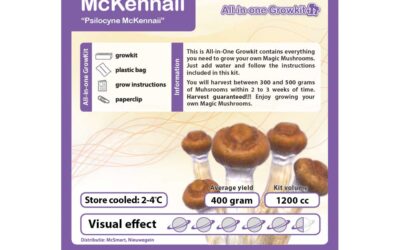
| McKennaii | Vigorous, dense growth, named after Terence McKenna | McKennaii grow kit |
| Mexican | One of the oldest known cubensis lines, smaller mushrooms | Mexican grow kit |
| Marshmallow | Pale, light-coloured caps | Marshmallow grow kit |
| Colombian | Line from South America, beginner-friendly | Read Golden Teacher vs Colombian |
How different are strains really? Research suggests the label tells you less than marketing claims:
- A genetic study of 81 Psilocybe genomes (McKernan et al., 2021) found that some strains sold under the same name by different vendors were genetically very similar, while others with the same name carried different genetics. Strain names are not a guarantee.
- A 2026 study in the Journal of Fungi grew 14 cubensis strains under identical lab conditions. The total tryptamine content differed more than 7.8-fold between strains, and even individual mushrooms of the same strain varied noticeably.
The practical takeaway: potency varies between strains, between flushes and between individual mushrooms, so no strain name tells you exactly what is in a given harvest. For tips on choosing a kit, read how to choose the right grow kit and our Golden Teacher guide.
Magic truffles: the sclerotia-forming species
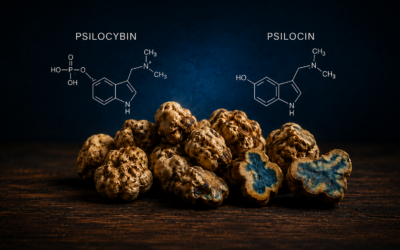
Magic truffles are not mushrooms in the usual sense. They are sclerotia: compact, underground masses of mycelium that some Psilocybe species form as a reserve. The main truffle-forming species are:
- Psilocybe tampanensis, first found near Tampa, Florida, in 1977
- Psilocybe mexicana, from central Mexico
- Psilocybe atlantis, first found near Atlanta, Georgia
- Psilocybe galindoi and Psilocybe pajaritos
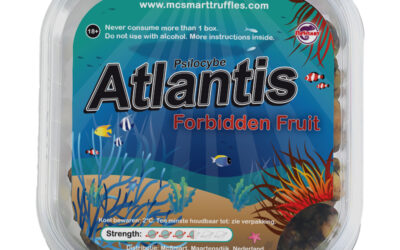
Truffle varieties in shops, such as Atlantis, Pink Paradise, Dutch Dragons or High Hawaiians, are trade names for sclerotia of these species. They contain the same compounds as mushrooms, usually in lower concentrations than dried mushrooms. In the Netherlands, psilocybin mushrooms have been on List II of the Opium Act since 1 December 2008, but truffles are not, which is why they are sold legally there. See all varieties in our magic truffles range, or compare them in the magic truffle buyer’s guide.
How to recognise magic mushrooms (and why you should not pick them)
Field guides list features such as a dark purple-brown spore print, a blue bruising reaction and a particular cap shape. In practice, these features are not enough for a non-expert. The EUDA warns that many psilocybin mushrooms resemble inedible or poisonous species.
The best known dangerous lookalike is Galerina marginata, the deadly galerina. According to the Beaty Biodiversity Museum (University of British Columbia), it contains amatoxins at levels comparable to the death cap. These toxins are not destroyed by cooking, symptoms often start only 6 to 10 hours after eating, and liver failure can follow days later. Galerina grows on the same wood chips as Psilocybe cyanescens; one difference is its rusty brown spore print, compared to the dark purple-brown spores of Psilocybe.
| Risk of wild picking | Why it matters |
|---|---|
| Deadly lookalikes | Small brown mushrooms are hard to tell apart, even with photos |
| Delayed symptoms | Amatoxin poisoning can feel fine for hours, then become critical |
| Unknown potency | Wild mushrooms vary widely in strength |
| Legal status | Picking and possessing mushrooms is illegal in many countries |
A known, controlled source removes the identification risk. A grow kit only grows the species it was inoculated with, and truffles are cultivated under controlled conditions. If you choose to use psilocybin, read our guide to using magic truffles responsibly and the overview of magic mushroom effects and risks.
Frequently asked questions
How many types of magic mushrooms are there?
More than 50 species contain psilocybin, according to the EUDA, mainly in the genera Psilocybe, Panaeolus and Copelandia. Within Psilocybe cubensis alone, growers have named dozens of strains.
What is the most common magic mushroom?
Psilocybe cubensis is the most cultivated species and is used in almost all grow kits. In the wild in Europe, the liberty cap (Psilocybe semilanceata) is the best known species.
Is Golden Teacher a different species?
No. Golden Teacher is a strain of Psilocybe cubensis, just like McKennaii, Mexican and Marshmallow. Strains differ in growth and appearance, but they are the same species.
Are some strains stronger than others?
Potency does vary. A 2026 lab study found a more than 7.8-fold difference in total tryptamines across 14 cubensis strains, with clear variation between individual mushrooms of the same strain too. A strain name alone does not tell you the exact strength.
Are magic truffles a type of magic mushroom?
They come from the same group of fungi. Magic truffles are sclerotia of species such as Psilocybe tampanensis, Psilocybe mexicana and Psilocybe atlantis, and contain the same compounds.
Can I safely pick magic mushrooms in the wild?
This is not recommended. Deadly species such as Galerina marginata look very similar and can grow in the same places. A grow kit or truffles from a known source avoid this risk.
Sources
- EUDA: Hallucinogenic mushrooms drug profile
- McKernan K et al. (2021). A whole genome atlas of 81 Psilocybe genomes as a resource for psilocybin production. F1000Research 10:961
- Kurzbaum E et al. (2026). Surprising variability in tryptamine profiles of Psilocybe cubensis fruiting bodies across 14 strains. Journal of Fungi 12(7):486
- Beaty Biodiversity Museum (UBC): Galerina marginata, deadly galerina
- GBIF: Psilocybe semilanceata
- Staatsblad 2008, 486: magic mushrooms added to List II of the Dutch Opium Act