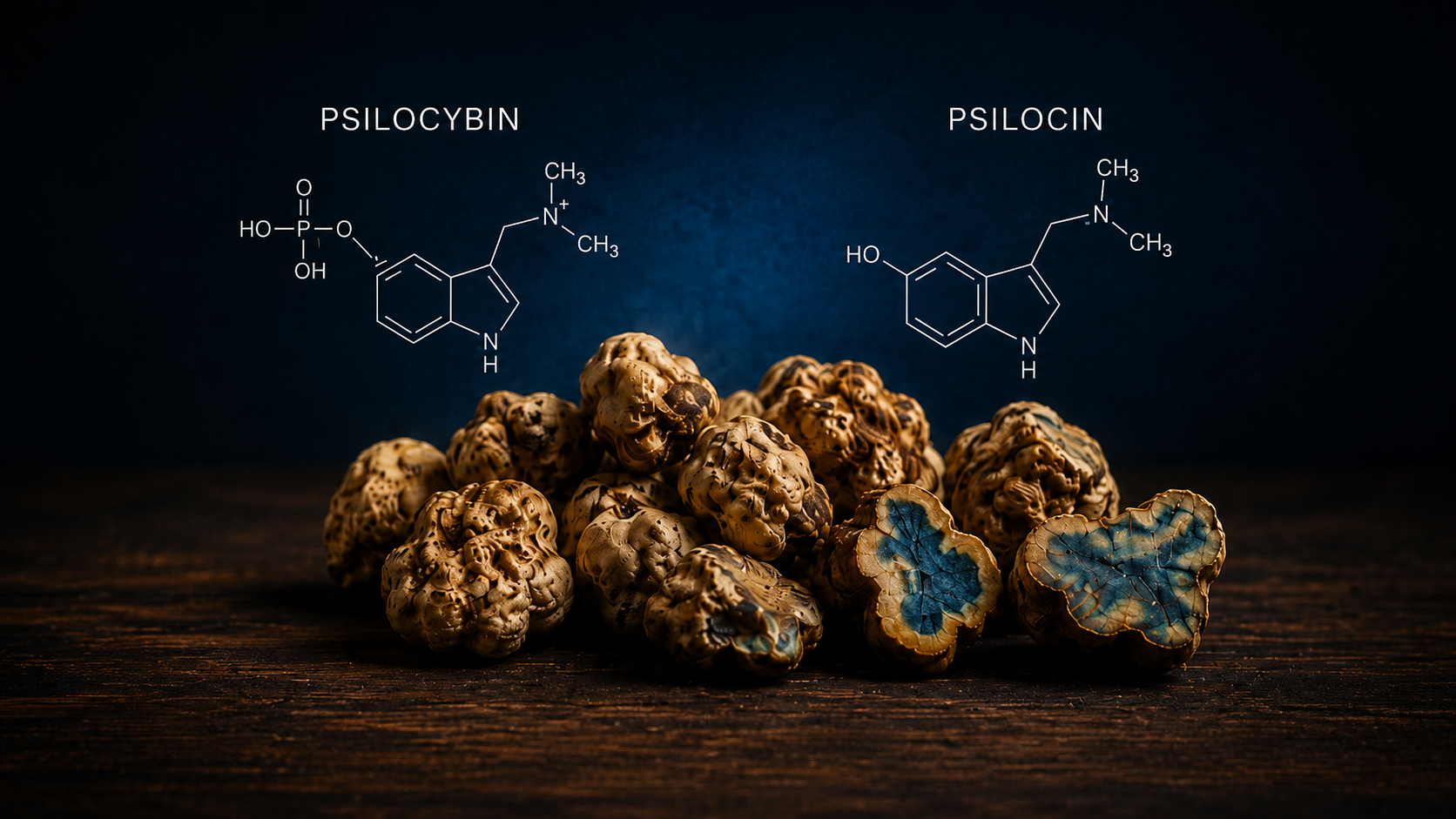
Short answer: psilocybin is a naturally occurring compound found in more than 50 species of mushrooms, mainly from the genus Psilocybe, and in the sclerotia sold as magic truffles. In the body it is converted into psilocin, which acts on serotonin receptors in the brain, especially the 5-HT2A receptor. This changes perception, mood and the sense of self for roughly 4 to 6 hours. Psilocybin is not an approved medicine in the EU, but it is one of the most actively researched psychedelics, with late-stage clinical trials under way and a first medical framework in Czechia since 2026.
This guide explains what psilocybin is, where it is found, how it works, what people report, which risks matter and where research stands today. For the chemistry in more depth, see our post on psilocybin vs psilocin.
What is psilocybin?
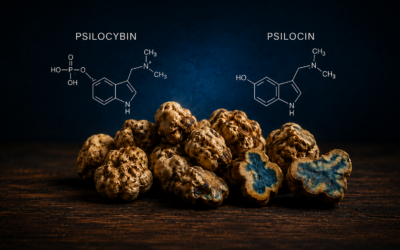
Psilocybin (4-phosphoryloxy-N,N-dimethyltryptamine) is a tryptamine alkaloid. Chemically it is related to serotonin, the neurotransmitter involved in mood, perception and many body functions. Its formula is C12H17N2O4P and its molar mass is about 284 g/mol.
Psilocybin itself is a so-called prodrug: it is not very active until the body changes it. After it is swallowed, enzymes remove the phosphate group (dephosphorylation) and psilocybin becomes psilocin, the compound that actually reaches the brain and produces the effects. Psilocin is less stable than psilocybin, which is why mushrooms and truffles slowly lose potency when exposed to air, light and heat. Our guide on how to store magic truffles covers this in practice.
Psilocybin rarely appears alone. Mushrooms also contain smaller amounts of related compounds such as baeocystin and norbaeocystin, which are thought to be less active.
| Compound | Role | Notes |
|---|---|---|
| Psilocybin | Main compound in the mushroom | Prodrug, converted in the body |
| Psilocin | Active form in the brain | Less stable, breaks down with oxygen |
| Baeocystin | Minor related alkaloid | Considered less active |
| Norbaeocystin | Minor related alkaloid | Considered less active |
Where is psilocybin found?
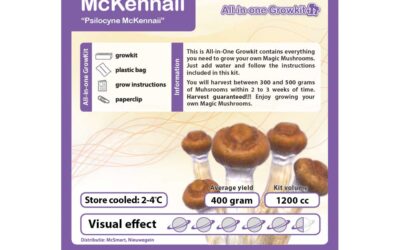
According to the European Union Drugs Agency (EUDA), psilocybin-containing fungi belong mainly to the genera Psilocybe, Panaeolus and Copelandia, with more than 50 species in total. The best known is Psilocybe cubensis, the species grown from most grow kits. You can read more in our Psilocybe cubensis guide.
Psilocybin is found in three main forms:
| Form | What it is | Where you encounter it |
|---|---|---|
| Mushrooms (fruiting bodies) | The visible mushroom with cap and stem | Wild species, grown at home |
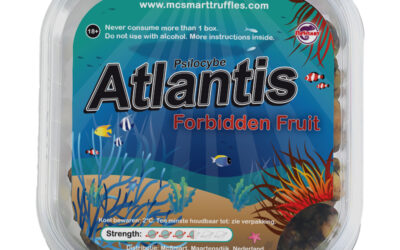
| Magic truffles (sclerotia) | Compact underground mycelium mass of certain Psilocybe species | Magic truffles |
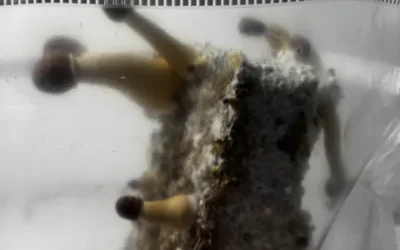
| Mycelium | The root-like network of the fungus | Inside a grow kit |
Truffles are not a different substance. They are another part of the same type of fungus and contain the same compounds, usually in lower concentrations than dried mushrooms. Our post on magic mushrooms vs magic truffles explains the difference.
One important safety point: many psilocybin mushrooms look like inedible or poisonous species. The EUDA names misidentification as a real hazard. Never pick and eat wild mushrooms unless an expert has identified them.
How psilocybin works in the brain
Psilocin binds to several serotonin receptors, including 5-HT1A, 5-HT2A and 5-HT2C. Most research points to stimulation of the 5-HT2A receptor as central to the psychedelic experience, although the EUDA notes that no single receptor has been proven to be solely responsible. Unlike LSD, psilocin does not act on dopamine receptors.
Brain imaging gives a picture of what happens at the network level. In a 2024 study in Nature, researchers at Washington University in St. Louis scanned volunteers before, during and after a controlled dose of psilocybin. The largest changes in connectivity were found in the default mode network, a set of brain regions that is most active when we are not focused on a task and that is linked to our sense of self, time and space. Most activity returned to normal within days, while one specific connection stayed reduced for at least three weeks. What this means in practice is still being studied.
Effects: what people report
Effects usually begin within about 30 minutes to an hour and last roughly 4 to 6 hours, depending on the person, the amount, the form and whether the stomach is empty. People commonly describe:
- brighter colours, patterns and changes in visual perception
- a changed sense of time
- strong emotions, from euphoria and laughter to anxiety
- introspection and a shift in how familiar thoughts feel
- in some cases, confusion, depersonalisation or a difficult experience (“bad trip”)
Physical effects are generally mild: dilated pupils, nausea, dizziness, shivering or muscle weakness, and a modest rise in heart rate and blood pressure. The experience depends strongly on mindset and surroundings, often called set and setting. For a closer description, read what does a magic truffle trip feel like and our wider guide to magic mushroom effects and risks.
Risks and who should be careful
Psilocybin has low physical toxicity and is not considered physically addictive. Tolerance builds quickly when it is used on consecutive days, which is one reason regular daily use is uncommon. The main risks are psychological and situational:
| Risk | Why it matters | Harm-reduction tip |
|---|---|---|
| Anxiety or panic | Can make the experience overwhelming | Calm setting, a sober person nearby |
| Accidents | Perception and judgement change | No driving, no swimming, no heights |
| Mental health history | People with (a family history of) psychosis or bipolar disorder appear more vulnerable | Avoid use |
| Medication interactions | Lithium is linked to seizures; MAO inhibitors can increase effects; antidepressants and antipsychotics may change effects | Check with a doctor first |
| Misidentified wild mushrooms | Poisonous lookalikes exist | Only use a known, controlled source |
A clinical overview in Psychiatric Times (2026) calls the combination with lithium “perhaps the most critical drug-drug interaction”. Mixing with alcohol or other substances also makes the experience less predictable. Our guide on using magic truffles responsibly covers preparation step by step.
A short history of psilocybin
Psilocybin mushrooms have a long history of ceremonial use in Mesoamerica. Western science took notice in the 1950s. In 1958 the Swiss chemist Albert Hofmann, working for Sandoz, identified psilocybin and psilocin, and his team synthesised psilocybin in 1959. Sandoz then supplied synthetic psilocybin under the name Indocybin for experimental and psychotherapeutic research in the 1960s. In 1971 psilocybin and psilocin were placed in Schedule I of the UN Convention on Psychotropic Substances, which slowed research for decades. Since the early 2000s, clinical research has grown again.
What the research says (2026)
The EUDA notes that psilocybin currently has no approved medical indication in Europe, while research explores its use for conditions such as treatment-resistant depression, PTSD and alcohol or drug dependence. Psilocybin in trials is always synthetic, given in a controlled clinical setting with psychological support. It is not comparable to self-use.
Key milestones so far:
| Year | Milestone |
|---|---|
| 2022 | Phase 2 trial in the New England Journal of Medicine: 233 people with treatment-resistant depression in 10 countries. The highest dose group improved more than the lowest at 3 weeks; serious adverse events also occurred and the authors called for close monitoring. |
| 2023 | Australia allows specially authorised psychiatrists to prescribe psilocybin for treatment-resistant depression. |
| 2025 | First phase 3 trial (COMP005) by Compass Pathways meets its primary endpoint. |
| 2026 | Czechia’s legal framework for psilocybin therapy in specialised facilities takes effect on 1 January. The National Institute of Mental Health said in March that treatment was not yet available pending insurance agreements. |
| 2026 | Second phase 3 trial (COMP006) meets its primary endpoint; Compass aims to complete its US approval filing in Q4 2026. |
These are research results, not proof that psilocybin works for any individual. If you want to read about smaller, sub-perceptual use, see the complete guide to microdosing with truffles and our microdosing range.
Psilocybin and the law
Psilocybin and psilocin are controlled under the UN 1971 Convention, but European countries treat the mushrooms themselves in different ways. In the Netherlands, psilocybin mushrooms were added to List II of the Opium Act on 1 December 2008. Magic truffles (sclerotia) are not on that list, which is why they are sold legally in the Netherlands. Read more in are magic truffles legal in the Netherlands.
Rules in other countries differ and can change, so always check the law where you live.
Frequently asked questions
What is psilocybin in simple terms?
Psilocybin is a natural compound in certain mushrooms and magic truffles. The body converts it into psilocin, which acts on serotonin receptors in the brain and temporarily changes perception, mood and thinking.
What is the difference between psilocybin and psilocin?
Psilocybin is the more stable form stored in the mushroom. Psilocin is the active form that the body makes from it after ingestion and that reaches the brain.
How long do the effects of psilocybin last?
Effects usually start within 30 to 60 minutes and last roughly 4 to 6 hours. Most people feel back to normal later the same day, though tiredness the next day is common.
Do magic truffles contain psilocybin?
Yes. Magic truffles are the sclerotia of certain Psilocybe species and contain psilocybin and psilocin, usually in lower concentrations than dried mushrooms.
Is psilocybin addictive?
Psilocybin is not considered physically addictive, and tolerance builds quickly with repeated use. The main risks are psychological and situational, such as anxiety, accidents and interactions with medication.
Is psilocybin an approved medicine?
Not in the EU. Czechia has allowed psilocybin therapy in specialised facilities since 2026 and Australia allows authorised psychiatrists to prescribe it, but it is not available as a regular medicine.
Can I buy a psilocybin supplement?
No legal psilocybin supplement exists. Functional mushrooms such as lion’s mane contain no psilocybin. See our mushroom supplements for non-psychedelic options.
Sources
- EUDA: Hallucinogenic mushrooms drug profile
- Serreau et al. (2022), A Review of Synthetic Access to Therapeutic Compounds Extracted from Psilocybe, Pharmaceuticals
- NIH Research Matters: How psychedelic drugs alter the brain (Siegel et al., Nature 2024)
- Psychiatric News: Depression improves following single dose of psilocybin (Goodwin et al., NEJM 2022)
- Psychiatric Times (2026): Psilocybin, a clinician’s guide to pharmacological interactions
- Monash Lens: The TGA has approved certain psychedelic treatments
- NUDZ (Czech National Institute of Mental Health): Official statement on the availability of psilocybin treatment
- Compass Pathways: Six-month data from second phase 3 trial (July 2026)
- Staatsblad 2008, 486: magic mushrooms added to List II of the Dutch Opium Act