Short answer: magic mushrooms are mushrooms that contain psilocybin, a compound the body converts into psilocin. Psilocin changes perception, mood and thinking for roughly 4 to 6 hours. They are not physically toxic in the way many drugs are, but they do carry real psychological risks, and fresh or dried magic mushrooms have been banned in the Netherlands since 2008. Magic truffles contain the same compounds and are legal there.
Looking to order? Read how to buy magic mushrooms online: truffles and grow kits compared.
This guide explains what magic mushrooms are, what the effects are like, the risks and who should avoid them, what research says, and how they differ from truffles. Sources are listed at the bottom.
What are magic mushrooms?
“Magic mushrooms” is the common name for mushrooms that contain psilocybin. Around 200 species are known, most of them in the genus Psilocybe. The best known is Psilocybe cubensis, which includes popular strains such as Golden Teacher.
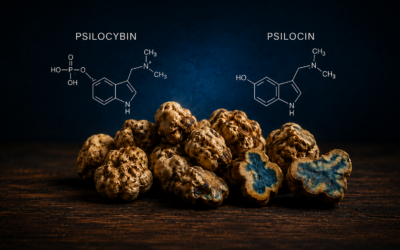
After you take them, the body converts psilocybin into psilocin. Psilocin acts mainly on serotonin 5-HT2A receptors in the brain, which is what causes the changes in perception and thinking. For a closer look at the chemistry, read psilocybin vs psilocin: what’s the difference?
What are the effects?
The effects depend heavily on the amount, the person and the situation (often called “set and setting”). Commonly reported effects include:
- Changes in how colours, sounds and patterns are perceived.
- A different sense of time.
- Stronger emotions, both pleasant and unpleasant.
- Thoughts that feel unusual, deep or hard to put into words.
- Physical effects such as nausea, dilated pupils and a slightly higher heart rate.
Effects usually start within 20 to 60 minutes and last about 4 to 6 hours. Not every experience is positive: anxiety and confusion are also common, especially at higher amounts. Read more in what a trip feels like and how long the effects last.
Magic mushrooms vs magic truffles
Magic truffles are not a different substance. They are sclerotia: compact, underground parts of the same kind of fungus. They contain the same active compounds, psilocybin and psilocin.
- Mushrooms are the fruiting bodies that grow above ground.
- Truffles grow underground as hard, nut-like lumps.
- Legal status in the Netherlands: fresh and dried magic mushrooms have been banned since 1 December 2008. Truffles fall outside that ban and are sold legally.
For a full comparison, read magic mushrooms vs magic truffles: what is the real difference? or browse our magic truffles.
Risks and side effects
Psilocybin has low physical toxicity, but that does not make it harmless. The main risks are psychological and situational:
- A difficult experience (“bad trip”). Panic, fear or confusion can be intense and is the most common reason people get into trouble.
- Accidents and risky behaviour while perception and judgement are altered.
- Psychosis. In people with a personal or family history of psychosis or bipolar disorder, psilocybin can trigger serious, lasting problems.
- Lingering visual changes (HPPD). Rare, but reported.
- Physical side effects: nausea, headache and a temporary rise in heart rate and blood pressure.
- Picking wild mushrooms. Some poisonous mushrooms look similar to psilocybin species. Mistakes can be fatal.
Do not use psilocybin if you are under 18, pregnant or breastfeeding, have a heart condition, have a personal or family history of psychosis or bipolar disorder, or take lithium or other psychiatric medication without talking to a doctor first.
How safe are they compared to other substances?
Compared with many other drugs, serious emergencies after magic mushrooms are rare. In an analysis of Global Drug Survey data (Kopra et al., 2022), about 0.2% of people who had used magic mushrooms in the past year reported needing emergency medical treatment. Most of those cases involved young people, anxiety or panic, and symptoms that resolved within a day.
Psilocybin is also considered to have a low potential for dependence. Tolerance builds very quickly, so repeating it on following days has little effect. Rare does not mean risk-free, though: the risks above are real, especially in the wrong setting or for the wrong person.
Long-term effects and risks
Most effects of psilocybin wear off within a day. What happens over months and years is less well studied, because most research looks at single sessions in clinical settings. What we know so far:
- Mental health in the general population. A large US population study (Krebs and Johansen, 2013, about 130,000 respondents) found no link between lifetime psychedelic use and higher rates of mental health problems. That is an average across a population. It does not rule out serious problems for individuals.
- Psychosis and bipolar disorder. People with a personal or family history of psychosis or bipolar disorder are the clearest risk group. In them, psilocybin can trigger or worsen symptoms that do not simply go away after the trip.
- Lingering visual changes (HPPD). Some people report visual effects such as trails, halos or visual snow long after use. Persistent, distressing cases are considered rare, but how often it happens is not well known.
- Difficult memories of a trip. A frightening experience can stay with people for weeks. Most recover without help, but some need support to process it.
- Dependence. Psilocybin is considered to have a low potential for dependence. Tolerance builds within a day or two, which makes daily use ineffective.
- Frequent use and the heart. Psilocin also binds to 5-HT2B receptors, which are linked to heart valve problems with some other drugs. For occasional use this is not seen as a concern. For long-term, frequent use such as months of microdosing, researchers say the risk has not been studied and cannot be ruled out (Tagen et al., 2023).
| Question | What research shows so far |
|---|---|
| More mental health problems in users overall? | No link found in large population data |
| Higher risk for some people? | Yes: personal or family history of psychosis or bipolar disorder |
| Lasting visual changes? | Reported, persistent cases considered rare |
| Addictive? | Low potential for dependence, fast tolerance |
| Long-term frequent use, such as microdosing? | Not well studied, heart valve question open |
If something feels off for longer than a few days after a trip, talk to a doctor or a drug information service. For microdosing specifically, read our complete guide to microdosing and browse the microdosing products.
What does the research say?
Psilocybin is being studied as a possible treatment, but always in clinical settings with screening and professional support. In the largest trial so far (Goodwin et al., 2022, 233 participants with treatment-resistant depression), a single 25 mg dose reduced depression scores more than a 1 mg dose after three weeks. Side effects were common, and some participants reported suicidal thoughts during the study.
These results are promising but early, and they do not show that using mushrooms on your own is a treatment. Microdosing has its own, more modest research picture, which we cover in our complete guide to microdosing.
How to reduce the risks
If you choose to use psilocybin, these basics make the biggest difference:
- Set and setting: only when you feel stable, in a calm and familiar place.
- A sober sitter: someone you trust who stays clear-headed.
- Start low: strength varies, so begin with a small amount and wait.
- Do not mix with alcohol, cannabis or other substances.
- Plan your day: no driving, no obligations, and time to rest afterwards.
Read the full checklist in how to use magic truffles responsibly and our dosage guide.
Frequently asked questions
How long do magic mushrooms last?
Usually about 4 to 6 hours, with effects starting after 20 to 60 minutes. Many people feel tired or reflective for the rest of the day.
Are magic mushrooms addictive?
Psilocybin is considered to have a low potential for dependence. Tolerance builds within a day or two, so frequent use quickly has little effect.
Can you overdose on magic mushrooms?
Physical toxicity is low, but taking too much can lead to an overwhelming experience, panic and accidents. The main dangers are psychological and situational.
Are magic mushrooms legal in the Netherlands?
No. Fresh and dried magic mushrooms have been banned since 1 December 2008. Magic truffles contain the same compounds and are legal to buy.
Are magic truffles the same as magic mushrooms?
They come from the same kind of fungus and contain the same active compounds, but truffles are the underground part (sclerotia) and mushrooms the fruiting body above ground.
Do magic mushrooms have long-term effects?
Most effects wear off within a day. Large population data show no link between psychedelic use and more mental health problems overall, but people with a history of psychosis or bipolar disorder are at higher risk, and lingering visual changes are occasionally reported. Long-term frequent use is not well studied.
Sources
- Kopra EI et al. (2022). Adverse experiences resulting in emergency medical treatment seeking following the use of magic mushrooms. Journal of Psychopharmacology. Read the study
- Goodwin GM et al. (2022). Single-dose psilocybin for a treatment-resistant episode of major depression. New England Journal of Medicine. Read the study
- Krebs TS, Johansen PØ (2013). Psychedelics and mental health: a population study. PLoS ONE. Read the study
- Martinotti G et al. (2018). Hallucinogen Persisting Perception Disorder: etiology, clinical features, and therapeutic perspectives. Brain Sciences. Read the study
- Tagen M et al. (2023). The risk of chronic psychedelic and MDMA microdosing for valvular heart disease. Journal of Psychopharmacology. Read the study
- DutchNews (2008). Magic mushrooms banned from December. Read the article