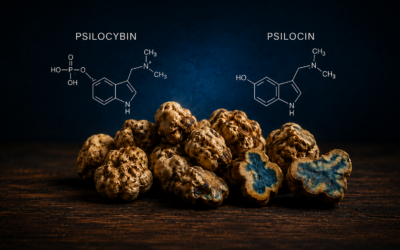
Short answer: usually not on a standard drug test. Common workplace panels look for substances such as cannabis, cocaine, opioids, amphetamines and PCP, and psilocybin is not part of them. That does not mean it cannot be found. Laboratories can detect psilocin, the active compound your body makes from psilocybin, when they run a specific test for it. In urine this is mostly possible for about a day, in blood for a shorter time, and in hair potentially much longer. Magic truffles contain the same compounds as magic mushrooms (“shrooms”), so the same applies to both.
This guide explains what a drug test looks for, what happens to psilocybin in your body, how long it can be detected and which factors play a role. It is meant as honest information, not as a guide to passing a test.
What a drug test actually looks for
Most drug tests start with a quick screening, usually an immunoassay on urine. That screening reacts to a fixed list of substances, called a panel. Whatever is not on the panel is simply not measured.
A clear example is the US federal workplace programme, often used as a reference for commercial tests. Its urine panel covers marijuana and cocaine metabolites, plus opioids such as codeine, morphine, hydrocodone and oxycodone, 6-acetylmorphine, phencyclidine (PCP), amphetamine and methamphetamine, and MDMA/MDA. Psilocybin and psilocin are not on that list.
To detect psilocin, a lab needs a targeted method, usually liquid or gas chromatography combined with mass spectrometry. Research groups have also built psilocin-specific immunoassays for blood, which shows that it takes a dedicated test rather than a standard screen. These targeted tests exist in forensic and clinical toxicology, but they are ordered for a reason, not run by default.
| Test type | Psilocin included by default? | When it can be found |
|---|---|---|
| Standard urine panel (workplace, 5 to 10 substances) | No | Not measured |
| Targeted urine test (lab, mass spectrometry) | Only when requested | Mostly within about 24 hours, longer when the lab also measures the glucuronide form |
| Blood test (lab) | Only when requested | Short: psilocin has a half-life of about 3 hours |
| Hair test (lab) | Rarely offered | Methods exist; hair can in principle reflect use over months |
| Saliva test | No | Little published data |
What happens to psilocybin in your body
Psilocybin is a prodrug. After you swallow magic truffles or mushrooms, enzymes quickly remove its phosphate group and turn it into psilocin, the compound that acts on serotonin receptors in the brain. Our post on psilocybin vs psilocin explains the chemistry, and the psilocybin guide gives the bigger picture.
The liver then processes psilocin further. Its main urinary metabolite is psilocin-O-glucuronide, a form in which psilocin is linked to glucuronic acid so the body can excrete it more easily. A review in Drug Metabolism Reviews describes this glucuronide as the metabolite most relevant for clinical and forensic diagnosis.
In a pharmacokinetic study with 12 healthy adults, published in Clinical Pharmacokinetics in 2017, psilocin had an average half-life of about 3 hours. No intact psilocybin was found in urine, and only a small part of psilocin left the body unchanged through the kidneys. In plain terms: psilocybin is converted fast, psilocin is broken down fast, and what reaches the urine is largely the glucuronide form.
How long psilocin can be detected
The best human data on urine come from a controlled study by Hasler and colleagues (2002). Eight volunteers took a measured oral dose of psilocybin and their urine was collected for 24 hours.
- Psilocin in urine peaked in the 2 to 4 hour window after intake.
- Concentrations usually fell to the lab’s lower measuring limit about 24 hours after intake.
- When the lab first split the glucuronide back into psilocin with an enzyme, the measured amount roughly doubled, and the researchers noted that this extends the period in which psilocin can be detected.
Blood behaves differently. With a half-life of about 3 hours, psilocin levels in blood drop quickly, so the window is counted in hours rather than days.
Hair is the exception. A team at the Institute of Legal Medicine in Münster published a validated method to measure psilocin in hair in 2015. Hair tests in general can look back over a period of months, but psilocin hair testing is specialised, rare and still based on limited real-world data.
These numbers come from small studies with measured doses of pure psilocybin. Real life varies more, so treat them as an indication, not a guarantee.
What affects detection
Several factors change how long psilocin stays measurable:
| Factor | Why it matters |
|---|---|
| Amount taken | More psilocybin means more psilocin and glucuronide to clear |
| Frequency of use | Repeated use over several days can lengthen the window |
| Individual metabolism | Enzyme activity, liver and kidney function differ per person |
| Type of test | A standard panel does not look for psilocin at all; a targeted lab test does |
| Lab method | Measuring the glucuronide form extends the detection window |
| Sample type | Blood is short, urine about a day, hair potentially months |
The review in Drug Metabolism Reviews also points out that individual physiological differences affect how people respond to and process psilocybin. Two people taking the same amount can therefore show different results.
Legal truffles and testing are two separate things
In the Netherlands, magic truffles are sold legally because sclerotia are not on List II of the Opium Act, unlike psilocybin mushrooms. You can read the background in are magic truffles legal in the Netherlands.
A legal purchase does not change what a lab measures. A test detects psilocin regardless of whether it came from truffles, mushrooms or another source, and it cannot tell them apart. Employer policies, sports rules, treatment programmes and traffic rules each have their own standards. Rules outside the Netherlands differ and can change, so always check what applies where you live.
Practical harm-reduction points
- Do not drive or operate machinery after using magic truffles. Perception and reaction time change, and the effects of a trip can last several hours. See how long do magic truffles last for timing.
- Do not try to cheat a test. Diluting urine, swapping samples or using additives are often detected by labs and usually count as a failed or refused test.
- Be open with a doctor if a test is part of medical care. Psilocin can interact with medication such as lithium, antidepressants and MAO inhibitors, and that matters more than a test result.
- Know what you take. Buying from a controlled source avoids misidentified wild mushrooms. Our magic truffles are sold as named, packaged varieties.
- Prepare properly. Our guide on using magic truffles responsibly and the overview of magic mushroom effects and risks cover set, setting and who should avoid use.
People who microdose take much smaller amounts, but they still take psilocybin. The same detection principles apply, and frequent use can extend the window.
Frequently asked questions
Do shrooms show up on a standard drug test?
Usually not. Standard workplace panels look for substances such as cannabis, cocaine, opioids, amphetamines and PCP. Psilocybin and psilocin are not part of them and are only found when a lab runs a specific test.
Do magic truffles show up differently than magic mushrooms?
No. Magic truffles and magic mushrooms contain the same compounds, psilocybin and psilocin. A test measures psilocin and cannot tell whether it came from truffles or mushrooms.
How long are shrooms detectable in urine?
In a controlled study, psilocin in urine peaked 2 to 4 hours after intake and usually dropped to the measuring limit after about 24 hours. Labs that also measure the glucuronide form can detect it somewhat longer.
Can a hair test detect magic truffles?
It is technically possible. A validated method to measure psilocin in hair was published in 2015, and hair can reflect use over months. In practice, psilocin hair tests are specialised and rarely ordered.
Can psilocybin cause a false positive for other drugs?
There is little published evidence that psilocybin triggers a positive result for other substances on standard screens. Any positive screening result is normally confirmed with a more precise lab method.
Does microdosing show up on a drug test?
Not on a standard panel. A targeted lab test could still find psilocin after a microdose, although the amounts are smaller. Frequent microdosing may lengthen the detection window.
Sources
- SAMHSA: Mandatory Guidelines for Federal Workplace Drug Testing Programs, Federal Register 2023
- Hasler et al. (2002), Renal excretion profiles of psilocin following oral administration of psilocybin: a controlled study in man, J Pharm Biomed Anal 30(2):331-339
- Brown et al. (2017), Pharmacokinetics of escalating doses of oral psilocybin in healthy adults, Clinical Pharmacokinetics
- Dinis-Oliveira (2017), Metabolism of psilocybin and psilocin: clinical and forensic toxicological relevance, Drug Metabolism Reviews
- Martin et al. (2015), Analysis of psilocin, bufotenine and LSD in hair, Journal of Analytical Toxicology 39(2):126-129
- Albers et al. (2004), Development of a psilocin immunoassay for serum and blood samples, International Journal of Legal Medicine
- Staatsblad 2008, 486: psilocybin mushrooms added to List II of the Opium Act