Short answer: psilocybin is not an approved medicine anywhere in the European Union, and you cannot buy it at a pharmacy. Access outside clinical trials is limited to a few tightly controlled routes. Czechia has had a legal framework for therapeutic use since 1 January 2026, Germany runs a compassionate use programme for treatment-resistant depression at two clinics, and Switzerland grants individual exceptional authorisations. The research, mostly in treatment-resistant depression, is promising but still being evaluated by regulators.
This guide explains what psilocybin therapy is, what the main studies found, how access works in each of these countries and what to expect next. It is based on official statements and published research, listed at the bottom.
What psilocybin therapy actually is
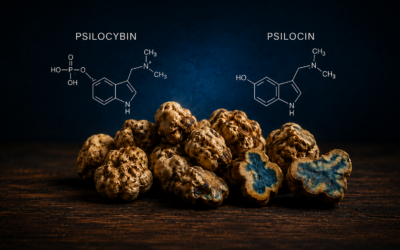
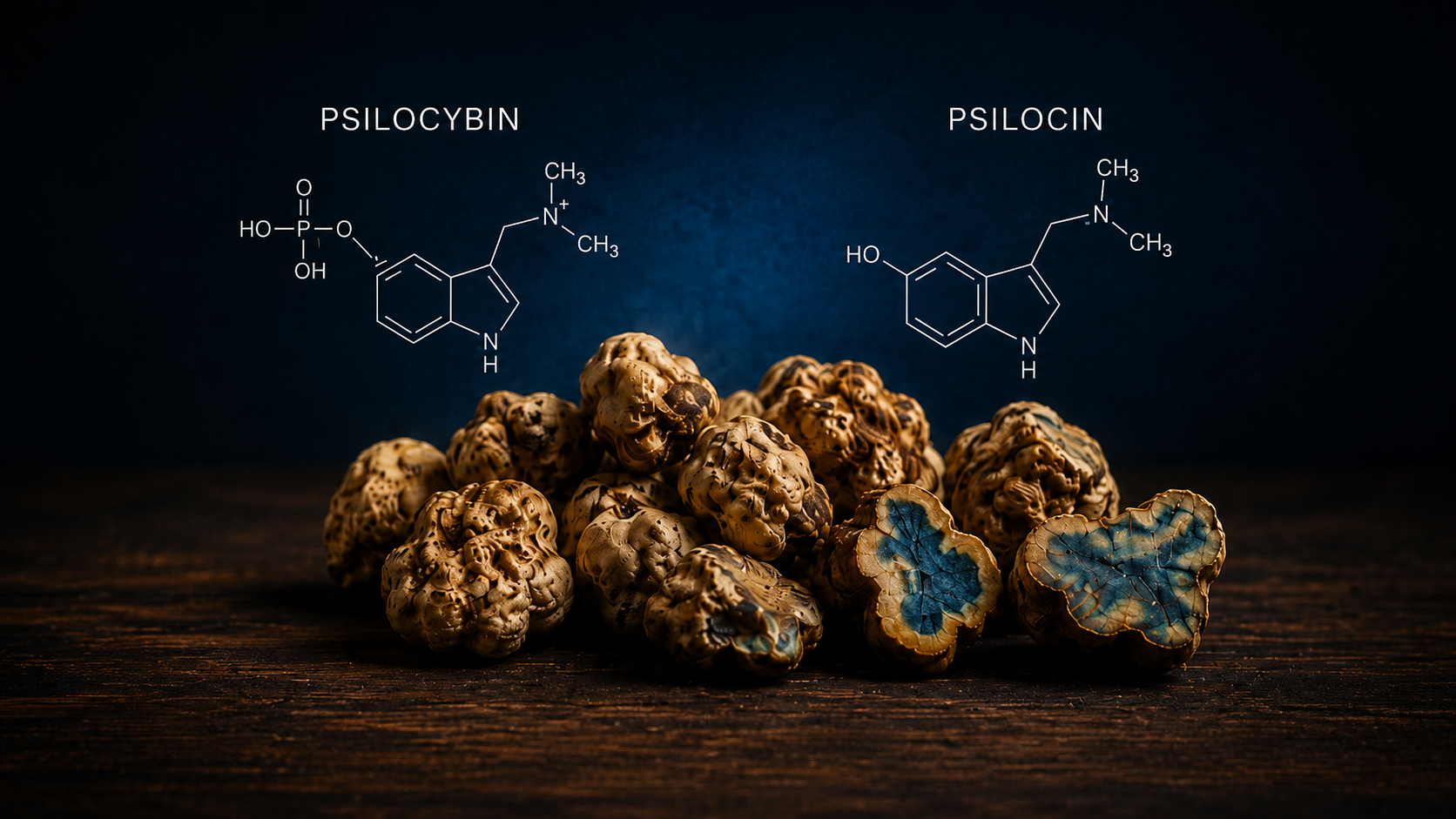
Psilocybin is the compound found in magic mushrooms and magic truffles. In the body it is converted to psilocin, which acts on serotonin receptors in the brain. Our psilocybin guide and the post on psilocybin vs psilocin explain the chemistry.
In a clinical setting, “psilocybin therapy” does not mean simply taking a pill. It is a structured programme with three parts:
- Preparation: screening by a psychiatrist, medical checks and sessions to build trust with the team.
- Dosing session: one or two sessions, each lasting around six hours, in a calm room with two trained professionals present the whole time.
- Integration: follow-up talks to make sense of the experience and connect it to ongoing treatment.
The psilocybin used in trials and programmes is a pharmaceutical product with a known, consistent content, either synthetic or a standardised botanical extract. That is a key difference from natural truffles or mushrooms, whose content varies.
What the research on depression shows
Most European activity focuses on treatment-resistant depression (TRD), usually defined as depression that has not responded well to at least two antidepressants. A few studies stand out.
| Study | Who took part | Main finding |
|---|---|---|
| Carhart-Harris et al., NEJM 2021 (Imperial College London) | 59 people with moderate to severe depression | Psilocybin was compared with the antidepressant escitalopram. Both groups improved; the difference on the main outcome was not statistically significant |
| Goodwin et al., NEJM 2022 | 233 people with TRD at 22 sites in 10 countries, many in Europe | A single 25 mg dose reduced depression scores more than a 1 mg control dose at week 3. The 10 mg dose did not differ from control |
| COMP005, phase 3 (Compass Pathways, 2025) | 258 people with TRD at US sites | A single 25 mg dose lowered depression scores by 3.6 points more than placebo at week 6 |
| COMP006, phase 3 (Compass Pathways, 2026) | 581 people with TRD | Met its main goal at week 6; six-month data were released in July 2026 |
Two points matter when reading these results. First, effects that look large in the news are often moderate in numbers, and they are measured against control groups that also improve. Second, blinding is hard: most participants can tell whether they received an active dose, which complicates the interpretation. The EUDA (the EU drugs agency) mentions both issues in its overview of therapeutic use of psychedelics.
Research also continues beyond depression. The EU-funded PsyPal project, coordinated by the University Medical Center Groningen, studies psilocybin therapy for psychological distress in patients with progressive illnesses such as COPD, multiple sclerosis, ALS and atypical Parkinson’s disease, across sites in the Netherlands, Portugal, Czechia and Denmark.
Where psilocybin therapy stands in Europe
| Country | Status in 2026 | Who can get it |
|---|---|---|
| Czechia | Legal framework in force since 1 January 2026; start of treatment expected in the second half of 2026, depending on insurance reimbursement | Selected patients with depression that does not respond to standard treatment, in approved healthcare facilities |
| Germany | Compassionate use programme authorised in summer 2025 | Patients with TRD who have failed at least two treatments and cannot join a trial, at two clinics |
| Switzerland | Exceptional authorisations under narcotics law, granted case by case | Patients with serious illness where conventional treatment has been exhausted |
| Netherlands | No medical access; clinical trials at university medical centres | Trial participants only |
| Italy | First clinical trial approved by the medicines agency AIFA in 2025 | Trial participants only |
| Other EU countries | Clinical trials only | Trial participants only |
Czechia
Czechia became the first EU country with a legal basis for therapeutic psilocybin. An amendment to the Criminal Code, in force since 1 January 2026, allows synthetic psilocybin to be used in specialised healthcare facilities. Treatment combines psilocybin with psychotherapy and is given by psychiatrists or clinical psychotherapists with specific training. Self-medication and home use remain prohibited.
In a statement from March 2026, the National Institute of Mental Health (NUDZ) said treatment was not yet available, that patients could not yet apply or join a waiting list, and that the launch was expected in the second half of 2026 once reimbursement rules were finalised. Check NUDZ for the latest status.
Germany
In August 2025, the federal drug agency BfArM authorised a compassionate use programme for psilocybin in treatment-resistant depression. It runs at two sites: the Central Institute of Mental Health (ZI) in Mannheim and the OVID Clinic in Berlin. Patients must have failed at least two standard treatments and be unable to join a clinical trial. Each session is supervised by two professionals, including a physician, and followed by integration therapy. Capacity was estimated at around 50 patients in the first year. The programme does not make psilocybin an approved medicine.
Switzerland
Switzerland, outside the EU, allows limited medical use through exceptional authorisations from the Federal Office of Public Health (FOPH). The treating physician applies per patient, and permits are only granted when conventional treatment has been exhausted and the patient suffers from a serious illness. Swiss courts have stressed that the scope for this is narrow. In 2022, 34 such licences were issued for psilocybin.
The Netherlands and Italy
In the Netherlands, psilocybin therapy is only available inside research. UMC Utrecht, UMC Groningen and Leiden UMC take part in a phase 3 follow-up study in difficult-to-treat depression. Selling magic truffles is legal in the Netherlands, but that is a separate matter from medical treatment (see are magic truffles legal in the Netherlands).
In Italy, AIFA approved the country’s first clinical trial of psilocybin in 2025. It is coordinated by the Istituto Superiore di Sanità and aims to include 68 patients with treatment-resistant depression over two years.
Can you get psilocybin at a pharmacy?
No. Because psilocybin is not an authorised medicine in the EU, no pharmacy can sell it on prescription or over the counter. Even in Czechia and Germany, it is handed out only within the approved programme, at the treatment site, during a supervised session.
Products sold online as “psilocybin pills” or “psilocybin capsules” are therefore not pharmacy medicines. Their content is unregulated and often unknown. If you are looking for legal mushroom products, functional mushroom supplements such as lion’s mane contain no psilocybin at all, a topic we will cover in a separate guide.
Risks and who is excluded
Clinical programmes screen carefully, and for good reason. The EUDA notes that most adverse events in trials happen during the acute effects and usually pass, such as anxiety. In the Goodwin trial, headache, nausea and dizziness were common, and suicidal thoughts and self-harm were reported more often in the higher-dose groups than in the control group. That is one reason why therapy includes close follow-up.
People are usually excluded from trials and programmes when they have:
- a personal or family history of psychosis or bipolar disorder
- uncontrolled high blood pressure or certain heart conditions
- medication that interacts with psilocybin, such as lithium; many trials also require stopping antidepressants first, under medical supervision
Therapy is not the same as a truffle session
It is tempting to see the research as proof that a truffle trip works as therapy. That is not what the studies show. Results come from screened patients, a pharmaceutical product with a fixed content, trained professionals and weeks of preparation and follow-up. None of that is present in an unsupervised session.
If you use magic truffles in the Netherlands, read our guides on using magic truffles responsibly and on magic mushroom effects and risks first. People who microdose take much smaller amounts, but the research on microdosing is a separate and less settled field; see our honest look at microdosing for creativity. If you are struggling with depression, talk to a doctor or psychiatrist. They can also tell you whether a clinical trial near you is recruiting.
What comes next
Compass Pathways is preparing its application to the US Food and Drug Administration, with final submission planned for the fourth quarter of 2026. Its 2026 updates do not give a timeline for an application to the European Medicines Agency. Until a European authorisation exists, access in the EU stays limited to trials and national schemes such as those in Czechia and Germany.
Expect slow, step-by-step change: reimbursement decisions in Czechia, results from the German programme and new trial data across Europe. We will update this page as the situation develops.
Frequently asked questions
Is psilocybin therapy legal in Europe?
There is no EU-wide approval. Czechia has had a legal framework for therapeutic use since 1 January 2026, Germany runs a compassionate use programme for treatment-resistant depression and Switzerland grants individual exceptional authorisations. Elsewhere in Europe, psilocybin therapy is only available in clinical trials.
Which country in Europe allows psilocybin therapy?
Czechia is the first EU country with a legal basis for therapeutic psilocybin, although treatment was still expected to start in the second half of 2026. Germany offers access through a compassionate use programme at two clinics, and Switzerland through case-by-case authorisations.
Can I buy psilocybin at a pharmacy?
No. Psilocybin is not an authorised medicine in the EU, so pharmacies cannot sell it. In the programmes that do exist, it is only given at the treatment site during a supervised session.
Does psilocybin work for depression?
Studies in treatment-resistant depression show that a supervised 25 mg dose with psychological support reduced symptoms more than a control dose or placebo. The size of the effect is moderate and regulators are still evaluating the data, so it is not yet an approved treatment.
How can I join a psilocybin trial?
Ask your psychiatrist or GP whether a trial is recruiting near you, or search the EU Clinical Trials Information System and ClinicalTrials.gov. Trials have strict inclusion rules and screen for conditions such as psychosis and heart problems.
Is a magic truffle session the same as psilocybin therapy?
No. Therapy uses a pharmaceutical product with a fixed content, screened patients, two trained professionals and structured preparation and follow-up. The research results do not apply to unsupervised use.
Sources
- EUDA: Frequently asked questions, therapeutic use of psychedelic substances
- NUDZ: Official statement on the availability of psilocybin treatment (March 2026)
- Expats.cz: Medical use of magic mushrooms to become legal in Czechia from 2026
- Drug Science: Germany’s compassionate use programme for psilocybin
- MLL News: Legal framework for the use of psychedelics in Switzerland
- Carhart-Harris et al. (2021), Trial of psilocybin versus escitalopram for depression, NEJM
- Goodwin et al. (2022), Single-dose psilocybin for a treatment-resistant episode of major depression, NEJM
- Psychiatric Times: COMP360 phase 3 efficacy data (COMP005), June 2025
- Compass Pathways: six-month data from second phase 3 trial (COMP006), July 2026
- University of Groningen: EU funds PsyPal research into psychedelic therapy
- UMC Utrecht: P-TRD study
- Il Post: first Italian clinical trial on therapeutic psilocybin (2025)