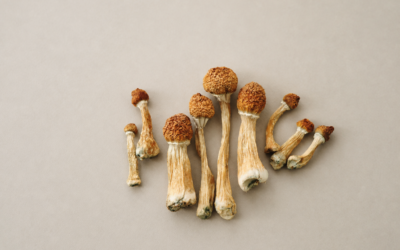
Short answer: Psilocybe cubensis is the most widely grown magic mushroom in the world. It contains psilocybin and psilocin, grows naturally in warm regions on the dung of grazing animals, and is easy to cultivate, which is why almost every grow kit, including Golden Teacher, is a cubensis. It is a different species from the fungi that produce magic truffles.
This guide covers the name and history, how to recognise it, why it turns blue, the best-known strains, how it compares to truffles and what you need to know about growing it. Sources are listed at the bottom.
Name and history
The species was first described in 1906 by American mycologist Franklin Sumner Earle, from specimens collected in Cuba, under the name Stropharia cubensis. In 1949 mycologist Rolf Singer moved it to the genus Psilocybe. The name cubensis simply means “from Cuba”.
From the 1970s onwards, simple home-growing methods made cubensis the standard mushroom for cultivators around the world.
How to recognise Psilocybe cubensis
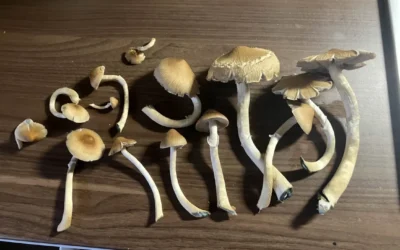
- Cap: golden to reddish brown, often lighter towards the edge, bell-shaped when young and flatter later.
- Stem: white to off-white, fairly thick, with a ring (annulus) near the top.
- Spore print: dark purple-brown to almost black.
- Bruising: turns bluish where it is touched or damaged.
- Habitat: tropical and subtropical regions, on or near the dung of cattle and other grazing animals.
Important: this is a general description, not a foraging guide. Some poisonous mushrooms look similar, and mistakes can be fatal. Never pick and eat wild mushrooms based on an article.
Why cubensis turns blue
The blue colour appears where the mushroom is damaged. Research by Lenz and colleagues (2020) showed that enzymes break down psilocybin and psilocin into compounds that link together into blue pigments. So the blue is a sign that psilocin is being broken down at that spot, not a reliable measure of how strong the mushroom is.
Active compounds and potency
Like other magic mushrooms, cubensis contains psilocybin, which the body converts into psilocin, plus small amounts of related compounds such as baeocystin. Potency varies a lot between strains, flushes and growing conditions, so a strain name alone says little about strength.
For the effects and risks of magic mushrooms in general, read magic mushrooms: effects, risks and how they differ from truffles. For the chemistry, see psilocybin vs psilocin.
The best-known strains
Cubensis “strains” are mostly names that growers give to lines with a particular look or growth behaviour. They are all the same species.
| Strain | Known for | Growing |
|---|---|---|
| Golden Teacher | Golden caps, the classic all-rounder | Forgiving, beginner-friendly |
| McKennaii | Vigorous, dense growth; named after Terence McKenna | Fast and robust |
| Mexican | One of the oldest known lines, smaller mushrooms | Reliable |
| Colombian | Line from South America | Beginner-friendly |
| Penis Envy | Unusual shape and a reputation for higher potency | Slower, more demanding |
Read more in our Golden Teacher guide and Golden Teacher vs Colombian.
Cubensis vs magic truffles
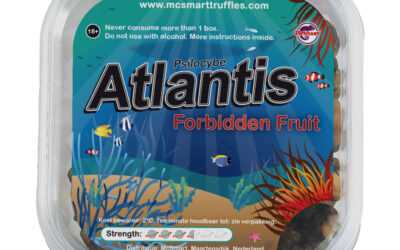
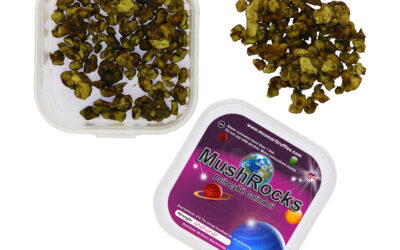
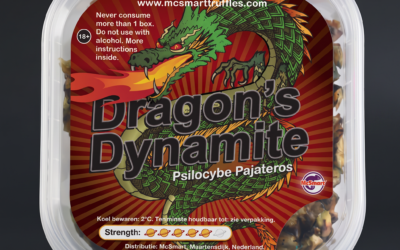
Magic truffles do not come from cubensis. They are sclerotia, underground growths of other species such as Psilocybe tampanensis, Psilocybe mexicana and Psilocybe atlantis. Cubensis does not form sclerotia.
- Same active compounds: psilocybin and psilocin.
- Different form: cubensis grows as mushrooms above ground, truffles as hard lumps underground.
- Legal status in the Netherlands: fresh and dried magic mushrooms are banned, fresh truffles are not.
Everything about truffles is in our complete guide to magic truffles.
Growing Psilocybe cubensis
Cubensis is popular with growers because it grows fast, tolerates small mistakes and does well indoors. A ready-to-use grow kit already contains fully colonised substrate, so you mainly need to provide:
- Warmth: a stable temperature, ideally around 24°C. A heat mat helps on cold days.
- Humidity and fresh air: regular misting and ventilation, as the kit instructions describe.
- Hygiene: clean hands and tools to prevent contamination.
- Patience: the first harvest usually comes within 2 to 3 weeks.
Step by step: how to grow magic mushrooms with a grow kit. Something going wrong? See grow kit not growing. Or browse our grow kits.
Frequently asked questions
What does cubensis mean?
It means “from Cuba”. The species was first described in 1906 from specimens collected in Cuba.
Is Golden Teacher a Psilocybe cubensis?
Yes. Golden Teacher, McKennaii, Mexican and most other grow kit strains are all Psilocybe cubensis.
Why do cubensis mushrooms turn blue?
Where the mushroom is damaged, enzymes break down psilocybin and psilocin into blue pigments. The colour does not tell you how strong a mushroom is.
Are cubensis and magic truffles the same?
No. They contain the same active compounds, but truffles come from other Psilocybe species that form underground sclerotia. Cubensis does not.
How long does it take to grow cubensis?
With a ready-to-use grow kit, the first harvest usually comes within 2 to 3 weeks, depending mainly on temperature.
Sources
- Psilocybe cubensis: taxonomy and history (overview). Read more
- Lenz C et al. (2020). Injury-triggered blueing reactions of Psilocybe “magic” mushrooms. Angewandte Chemie. Read the study
This article is for informational and educational purposes only and is not medical advice. Mindrush only sells products that are legal under Dutch law and intended for adults (18+). Laws differ per country; readers are responsible for checking the laws that apply to them.